


What a Web Design Portfolio Actually Reveals
You've reached the point where your current website no longer serves its purpose. Maybe it's outdated. Maybe it never worked well in the first place. Regardless, you're now on the hunt for someone capable of building something better.
The search almost always begins the same way — scrolling through online portfolios, trying to distinguish competent work from well-packaged mediocrity. That challenge is harder than it appears because portfolios are curated artifacts. They exist to flatter, not to educate.
Bridging the gap between admiration and assessment requires deliberate effort. The principles outlined here provide a concrete method for reading portfolios with the scrutiny they deserve.
Don't Overvalue the Hero Section
Every portfolio gravitates toward its most photogenic homepage designs. Bold headlines, striking imagery, and spacious layouts are the tools of choice for making a strong first impression. They accomplish that goal effectively.
The limitation is obvious once you notice it. A real website extends far beyond its entrance. Users interact with account pages, category browsing, checkout processes, and dozens of secondary screens that collectively define whether the experience succeeds or fails. These components are almost always absent from a curated showcase.
When you encounter a web design company presentation built exclusively around landing pages, treat it as an invitation to ask for more. Request to see the breadth of any featured project. Whether someone has handled the complete scope of a website or merely its most decorative surface is a distinction worth establishing early.
Adaptability With a Coherent Standard
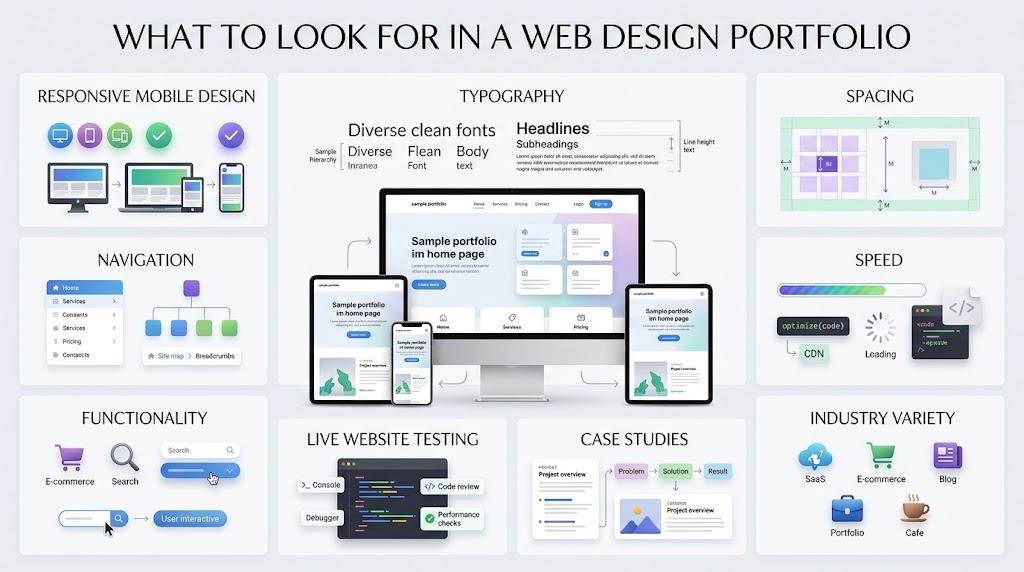
A strong portfolio demonstrates range. Work spanning different industries, audience profiles, and content strategies proves that the creator can adjust their approach to each situation rather than recycling a single template repeatedly.
But range without a unifying quality standard raises concerns. When projects differ dramatically in both execution and reasoning, the portfolio may reflect trend-chasing behavior rather than principled problem-solving. Chasing what's fashionable today often produces work that feels dated within months.
What signals genuine capability is a collection where each project feels individually considered yet shares a consistent commitment to clarity and usability. A web design company that produces distinctive work for each client while upholding that baseline is demonstrating judgment you can rely on.
The Case for Narrative Context
Screenshots tell you what something looks like. They remain silent on why particular decisions were made, what obstacles shaped the outcome, or how the creator navigated competing priorities. That silence creates an evaluation gap that's difficult to bridge.
Portfolios enriched with project descriptions — even two or three sentences explaining objectives, challenges, and rationale — fundamentally change what you're able to assess. You move from judging surfaces to understanding processes, and processes are what ultimately determine whether someone can serve your needs.
If the work you're reviewing contains no explanatory material, raise the topic in your earliest conversation with that web design company. Ask what problems each featured project was addressing. The specificity and honesty of those answers provide more insight than any amount of visual polish.
Responsive Work Should Be Non-Negotiable
Any portfolio that presents desktop views exclusively is missing an essential component. With the majority of web traffic now arriving through mobile devices, responsive design represents a baseline competency, not a premium add-on.
Effective responsiveness requires more than proportionally reducing element sizes. It demands rethinking content hierarchy for narrow viewports, redesigning navigation for touch interaction, and accommodating variable connection speeds. Each of these introduces distinct design problems.
A practiced website designer will include responsive examples without being prompted and will speak fluently about the compromises involved. When someone's body of work contains no evidence of mobile execution, that absence should weigh heavily in your evaluation. It reflects priorities that may not align with your needs.
Align Expertise With Your Specific Requirements
A frequent error in portfolio assessment involves substituting personal aesthetic preference for functional evaluation. The work that appeals to your taste might share virtually no structural overlap with what your project actually demands.
Different organizations face fundamentally different web challenges. A publishing platform requires different architectural thinking than a service business or a product catalog. The skills that make someone excellent in one context don't automatically translate to another.
Examine portfolios through a functional lens. Has this web design company managed comparable challenges around information density, user task completion, or content organization? Those structural parallels predict compatibility with your project far more reliably than whether the visual style personally resonates with you.
Typography and Spacing as Diagnostic Tools
Evaluating these elements requires no specialized knowledge. Open any portfolio piece and read the text. Does the sizing feel comfortable? Is line spacing sufficient for extended reading? Do adjacent elements maintain appropriate distance from one another?
Whitespace serves an architectural function. It creates hierarchy, establishes rhythm, and provides the visual breathing room that allows complex pages to remain navigable. Consistent mastery of these fundamentals typically reflects broader attention to craft.
A web design company that demonstrates clean type and balanced spatial relationships across its entire body of work is signaling values that extend well beyond aesthetics. Conversely, cramped layouts and inconsistent text sizing frequently indicate foundational issues that affect the overall quality of the work.
Usability Is the Ultimate Test
A visually impressive website that doesn't function well is ultimately a failure. When examining portfolio samples, adopt the perspective of an end user. Could you accomplish a task here without confusion? Is the navigation self-evident?
Engage with every live example available. Walk through the menus, complete available forms, and test how quickly elements respond to interaction. These practical experiences reveal information that static screenshots fundamentally cannot communicate.
Patterns That Warrant Investigation
Several recurring portfolio characteristics merit closer attention:
- A collection composed entirely of static mockups with no published live work. There may be legitimate explanations, but the absence always deserves inquiry.
- No evidence of recent activity. The field evolves rapidly, and a portfolio frozen in time may not reflect someone's current knowledge or awareness of contemporary standards.
- No clarity around individual contribution. Without understanding whether someone led a project from beginning to end or played a supporting role within a larger team, you cannot fairly assess their individual capabilities.
- Visual variety masking structural uniformity. When different projects share nearly identical layouts beneath different color schemes and imagery, the actual range of problem-solving ability may be more limited than the surface variety suggests.
None of these patterns independently disqualifies a candidate. Multiple concurrent indicators, however, form a profile that merits transparent, direct conversation before any commitment is made.
The Process Conversation Is Critical
Portfolios display outcomes. They conceal every step that led to those outcomes. Understanding that invisible process is essential for predicting how the working relationship will unfold.
When reaching out to a web design company or independent creator, ask targeted questions about their methodology. How do they extract clear requirements from ambiguous client briefs? What discovery work precedes the first design concept? How many revision cycles does their standard engagement include?
You're entering a collaborative relationship that will span weeks or months. Ensuring alignment on workflow, communication frequency, and decision-making structure before any agreement is signed protects both parties and substantially improves the chances of a successful result.
Start With Feeling, End With Evidence
A portfolio that evokes a genuine response deserves attention. When work feels deliberate, carefully considered, and executed with precision, that reaction usually reflects authentic qualities in the creator's approach. It's worth paying attention to that signal.
But instinct must be supported by verification. Visit every live project listed. Request references and speak honestly with past clients about punctuality, communication quality, and how unforeseen challenges were handled throughout the engagement. These conversations provide depth that visual materials alone cannot offer.
Hiring a web designer represents a consequential decision with effects extending well beyond the project's completion. The person you select will define how every visitor perceives your organization from their very first interaction with your site.
Dedicate additional time to careful, thorough evaluation. You don't need technical expertise or design knowledge to choose the right collaborator. You need only the willingness to look past the surface and the diligence to verify what your instincts suggest.

 English
 Arabic
 French
 Spanish
 Portuguese
 Deutsch
 Turkish
 Dutch
 Italiano
 Russian
 Portuguese (Brazil)
 Greek