


Can Artificial Intelligence and Edge Computing Unlock China’s IoT Cloud Platform Market?
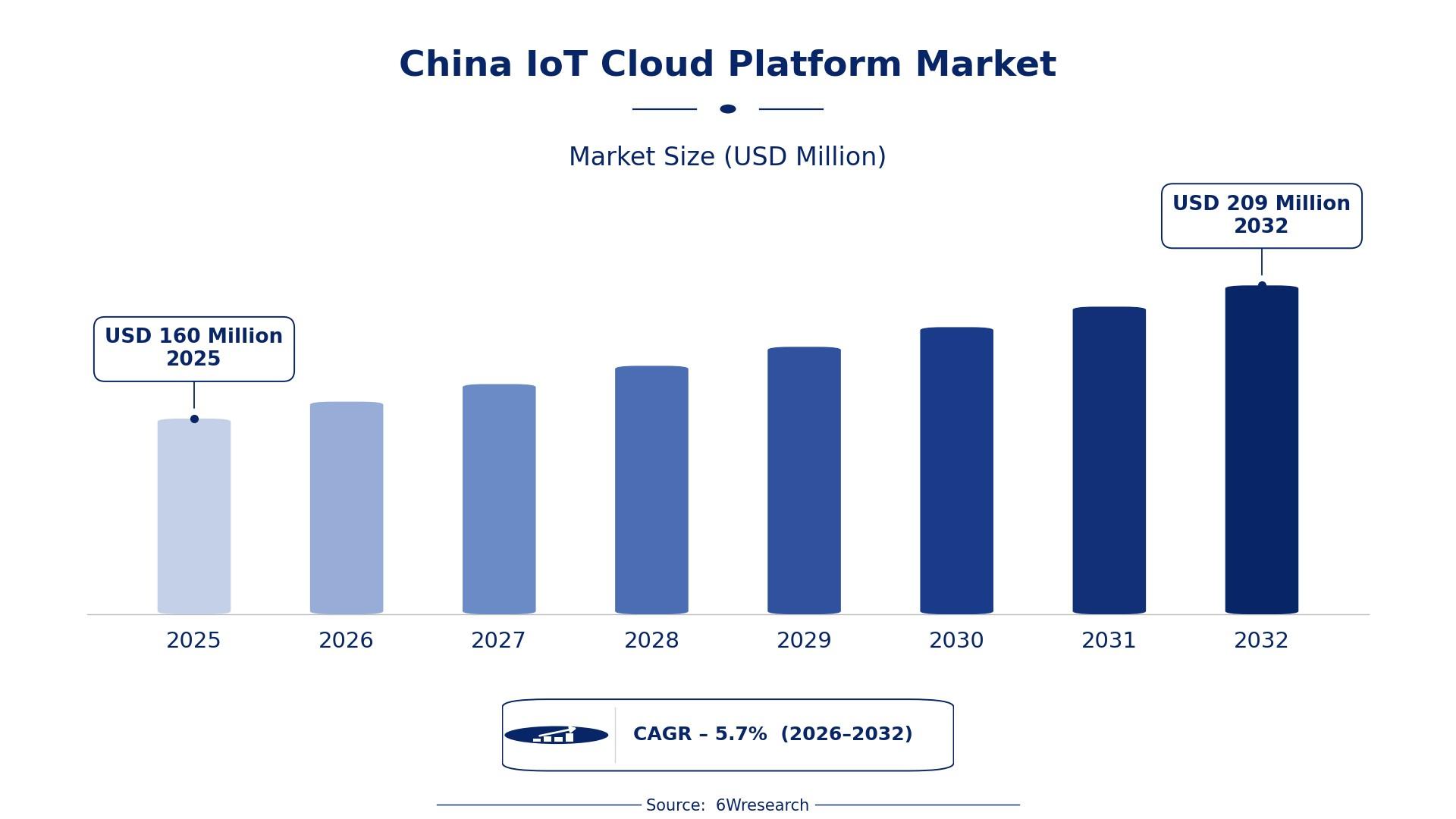
The China IoT Cloud Platform Market is entering a technology-driven phase as organizations look beyond basic device connectivity toward intelligent monitoring, automated analysis, and faster decision-making. Artificial intelligence (AI), edge computing, and advanced cloud infrastructure are helping businesses extract more value from information generated by connected devices. According to 6Wresearch, the market is projected to grow from USD 160 million in 2025 to USD 209 million by 2032, representing a CAGR of 5.7% during 2026–2032.
From Connected Devices to Intelligent Operations
Traditional IoT deployments often focused on collecting sensor readings and displaying them through dashboards. Businesses increasingly want systems that can interpret those readings, detect unusual patterns, and help teams determine what action to take.
Cloud platforms provide the computing resources needed to aggregate information from distributed devices and apply analytical models. In manufacturing, this can help teams investigate equipment performance. In commercial buildings, analytics can reveal unusual energy consumption. In logistics, connected tracking systems can improve visibility into vehicle and shipment conditions.
The value of AI depends on the problem being addressed. Businesses should prioritize practical improvements rather than introducing advanced technology without clear operational objectives.
Why Is Edge Computing Important?
Transmitting every sensor reading to a distant cloud environment can increase bandwidth usage and create delays. Edge computing addresses these limitations by processing selected information close to where it is generated.
This approach is valuable when equipment needs a rapid response or must continue operating during temporary connectivity interruptions. Industrial machines, transport infrastructure, and building-control systems may benefit from local processing for time-sensitive tasks.
A combined architecture can distribute responsibilities effectively:
-
At the edge: Filter data, detect immediate anomalies, and support local responses.
-
In the cloud: Aggregate information across facilities, maintain historical records, and run broader analytics.
-
Across the system: Coordinate device identities, software updates, monitoring, and security policies.
The right balance depends on application requirements, connectivity, and the consequences of delayed decisions.
Where Can AI-Enabled IoT Create Value?
Smart manufacturing offers opportunities for predictive maintenance, production monitoring, and quality analysis. Sensors can identify changes in machine behavior, while cloud-based systems compare operating patterns across production lines or facilities.
Smart transportation provides another application area. Connected road infrastructure and fleet-monitoring devices can help operators understand traffic patterns, vehicle performance, and maintenance requirements. In retail, connected inventory and environmental monitoring systems can improve operational visibility.
Healthcare organizations may use connected equipment for monitoring and maintenance, subject to appropriate clinical oversight, privacy requirements, and reliability standards.
Why Does Data Quality Matter?
AI systems rely on accurate, relevant information. Inconsistent readings, missing records, incompatible device formats, and poorly maintained sensors can reduce analytical reliability.
Organizations should establish data-quality checks and validate analytical results before using them to guide important decisions. They should also monitor model performance over time because operating conditions and device behavior can change.
Useful implementation priorities include:
-
Define a measurable operational problem.
-
Confirm sensor accuracy and data availability.
-
Integrate information from compatible systems.
-
Test analytical results against real operating conditions.
-
Establish procedures for investigating alerts and recommendations.
Security in Intelligent IoT Environments
AI and edge computing expand the number of components requiring protection. Devices, gateways, cloud interfaces, and analytical applications can all introduce potential security risks.
Businesses should prioritize secure device onboarding, encryption, access management, firmware updates, anomaly monitoring, and incident-response planning. They should also understand applicable Chinese requirements for data handling and storage.
Security should be incorporated into architecture and procurement decisions from the beginning, rather than treated as a final implementation step.
What Will Shape Market Opportunities Through 2032?
The combination of AI, edge computing, and cloud analytics could create opportunities across manufacturing, transport, utilities, healthcare, and smart buildings. Providers may differentiate themselves through specialized applications, dependable integration, and analytics that deliver measurable operational benefits.
Businesses evaluating solutions should compare reliability, latency, integration requirements, security, and lifecycle costs. As the market develops, platforms that balance intelligent capabilities with manageable implementation and maintenance may attract stronger customer interest.
About 6Wresearch
About 6Wresearch: 6Wresearch is a commercial strategy and growth advisory firm founded in 2011 and headquartered in New Delhi, India, with partners across Southeast Asia and the Middle East & Africa. The firm has delivered over 20,000 commercial engagements for over 2,000 organizations, including Fortune 500 companies, government agencies, and multilateral institutions such as the World Bank and the Asian Development Bank. Backed by proprietary market research and advanced analytics, 6Wresearch combines sector expertise with data-driven intelligence to help organizations navigate market complexity and drive sustainable growth. These capabilities explain why organizations trust 6Wresearch Global Market Research & Consulting Firm for reliable commercial insights and confident decision-making.
Our Proprietary Platform: 6W Export GTM
6W Export GTM is 6Wresearch's proprietary trade intelligence and go-to-market platform, built on UN Comtrade data and enhanced with 6Wresearch's in-house analytical and simulation models, including system dynamics-based forecasting. Unlike broad, sector-level market sizing tools, 6W Export GTM operates at the individual product level down to specific HS codes and micro-segments to identify precise, actionable export opportunities by country and product pair, including markets where trade currently does not exist. This granular, simulation-driven approach allows 6W Export GTM to surface opportunities that sector-wide analysis typically misses, positioning it among a small number of platforms globally offering this depth of product-and-country-specific export intelligence.

 English
 Arabic
 French
 Spanish
 Portuguese
 Deutsch
 Turkish
 Dutch
 Italiano
 Russian
 Romaian
 Greek