


Mental Health Billing Services in the USA: The Key to Financial Stability for Behavioral Health Practices
Introduction
The demand for behavioral and psychiatric care across the USA has grown significantly in recent years. As more individuals seek support for anxiety, depression, trauma, substance use disorders, and other mental health conditions, providers are experiencing increased patient volumes and administrative responsibilities. While delivering quality care remains the top priority, managing claims, insurance requirements, and reimbursement processes can quickly become overwhelming.
This is where mental health billing services play a critical role. Accurate billing not only ensures timely reimbursements but also helps behavioral health providers maintain compliance, reduce claim denials, and improve overall financial performance.
From solo therapists and psychologists to large behavioral health organizations, many practices rely on specialized billing support to streamline operations and focus more on patient care rather than paperwork.
Understanding Mental Health Billing Services
Unlike general healthcare billing, mental health medical billing involves unique coding requirements, therapy-specific documentation standards, authorization processes, and payer regulations.
Mental health providers frequently bill for services such as:
- Individual therapy sessions
- Group counseling
- Family therapy
- Psychiatric evaluations
- Medication management
- Telehealth consultations
- Substance abuse treatment programs
- Intensive outpatient programs (IOP)
Each service requires proper coding, documentation, and claim submission procedures to ensure reimbursement. Even minor mistakes can result in delayed payments or denied claims.
Professional billing services for mental health practices help manage these complexities while improving revenue collection and operational efficiency.
Why Mental Health Billing Is More Complex Than Other Specialties
Behavioral health billing presents several challenges that differ from many traditional medical specialties.
Frequent Insurance Policy Changes
Insurance companies regularly update behavioral health coverage guidelines, authorization requirements, and reimbursement policies. Staying current with these changes requires ongoing monitoring and expertise.
Session-Based Billing
Most mental health services are billed according to session duration. Incorrect time documentation can lead to coding errors and reimbursement issues.
Authorization Requirements
Many insurance plans require prior authorization for ongoing therapy, psychiatric treatment, or intensive outpatient services. Missing authorizations often result in claim denials.
Telehealth Regulations
Virtual behavioral health services continue to grow, but telehealth billing rules vary by payer and state. Providers must ensure compliance with evolving reimbursement guidelines.
Because of these complexities, specialized billing for mental health services often produces better financial outcomes than handling billing internally without dedicated expertise.
Benefits of Outsourcing Mental Health Billing
Many behavioral health organizations are turning to dedicated billing specialists to improve revenue performance and reduce administrative burdens.
Improved Claim Accuracy
Experienced billing professionals understand behavioral health coding requirements and payer-specific rules. Accurate claim submission significantly reduces denial rates.
Faster Reimbursements
Clean claims are processed more efficiently, leading to quicker payments and healthier cash flow.
Reduced Administrative Workload
Therapists, psychiatrists, and counselors can spend more time focusing on patient care instead of insurance follow-ups and billing corrections.
Better Revenue Tracking
Comprehensive reporting allows providers to monitor collections, denial trends, and overall financial performance.
Enhanced Compliance
Professional billing teams stay updated on payer policies, HIPAA requirements, and industry regulations.
These advantages make mental health billing solutions a valuable investment for practices seeking long-term growth.
Common Challenges in Mental Health Billing
Even highly experienced providers encounter billing difficulties.
Claim Denials
Common reasons for denials include:
- Incorrect diagnosis codes
- Missing documentation
- Invalid CPT codes
- Authorization issues
- Eligibility verification errors
Underpayments
Insurance companies occasionally reimburse less than contracted rates. Without regular payment audits, providers may lose revenue without realizing it.
Eligibility Issues
Failure to verify patient benefits before appointments can lead to unexpected payment disputes and claim rejections.
Documentation Gaps
Incomplete clinical notes may not support billed services, increasing the likelihood of audits and denials.
Effective mental health billing processes address these challenges before they impact revenue.
The Role of Medical Coding in Behavioral Health Billing
Accurate coding serves as the foundation of successful reimbursement.
Behavioral health providers use a combination of:
- ICD-10 diagnosis codes
- CPT procedure codes
- HCPCS codes when applicable
Professional medical coding services ensure that diagnoses and procedures are properly documented and coded according to current guidelines.
Coding accuracy directly impacts:
- Claim approval rates
- Compliance standards
- Audit preparedness
- Reimbursement levels
Even a small coding mistake can trigger claim denials or payment delays, making coding expertise essential for behavioral health organizations.
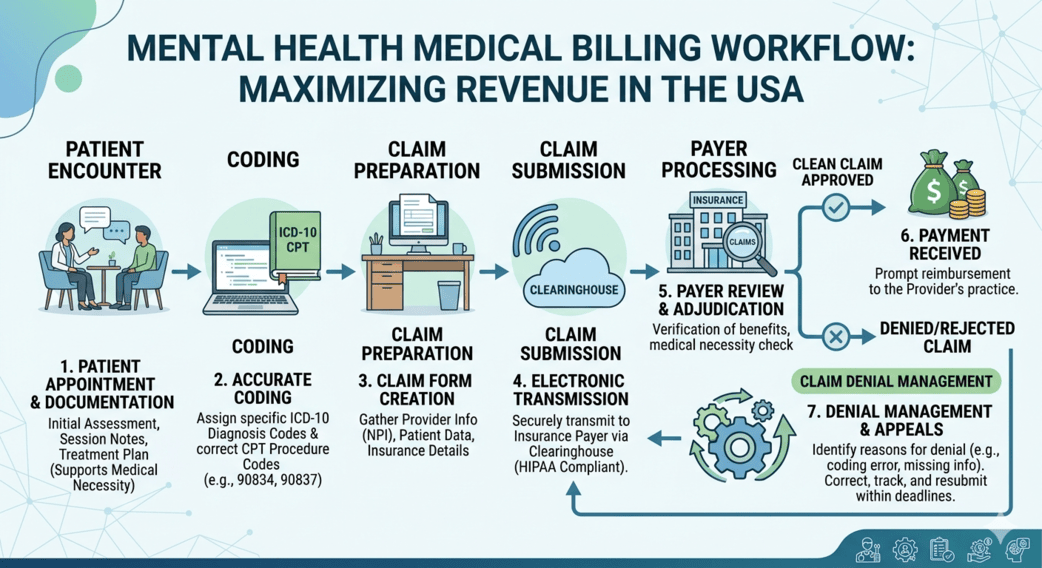
How Medical Billing Services Support Mental Health Providers
Comprehensive medical billing services extend far beyond claim submission.
A well-managed billing process typically includes:
Insurance Verification
Confirming patient eligibility before appointments helps reduce claim rejections and billing disputes.
Charge Entry
Accurate entry of diagnoses, procedures, and patient information ensures claim integrity.
Claim Submission
Claims are electronically submitted to insurance carriers for processing.
Payment Posting
Payments are recorded and reconciled against expected reimbursement amounts.
Denial Management
Denied claims are reviewed, corrected, and resubmitted promptly.
Patient Billing
Providers receive support managing patient statements and payment collections.
This end-to-end approach strengthens financial performance while reducing administrative stress.
Why Revenue Cycle Management Matters in Behavioral Health
Many providers focus primarily on claim submission while overlooking the larger revenue cycle.
Effective revenue cycle management services encompass every stage of the payment process, from patient scheduling to final reimbursement.
Key components include:
- Patient registration
- Eligibility verification
- Authorization management
- Coding review
- Claim submission
- Denial management
- Payment reconciliation
- Reporting and analytics
Strong revenue cycle management helps identify inefficiencies before they become costly problems.
For behavioral health practices, even minor improvements in collection rates can generate substantial long-term financial benefits.
Credentialing Services and Their Impact on Reimbursements
Many behavioral health providers underestimate the importance of proper credentialing.
Insurance companies require providers to complete credentialing before claims can be reimbursed. Delays or errors in credentialing may prevent providers from receiving payment altogether.
Professional credentialing services assist with:
- Provider enrollment
- Insurance panel applications
- CAQH maintenance
- Recredentialing updates
- Payer communications
Timely credentialing allows providers to participate with insurance networks and begin billing without unnecessary delays.
Choosing the Right Mental Health Billing Company
Not all billing vendors specialize in behavioral health.
When evaluating a mental health billing company, providers should consider:
Behavioral Health Experience
Look for a team with proven expertise in psychiatry, psychology, counseling, and substance abuse treatment billing.
Denial Management Capabilities
Strong denial resolution processes can significantly improve revenue recovery.
Reporting Transparency
Access to financial reports helps providers monitor practice performance.
Technology Integration
Billing systems should integrate smoothly with electronic health records and practice management software.
Compliance Knowledge
The company should remain current with payer regulations and behavioral health billing requirements.
Selecting the right partner can have a lasting impact on operational efficiency and profitability.
How Mental Health Billing Companies Improve Practice Growth
Leading mental health billing companies do more than process claims.
They help practices:
- Increase collections
- Reduce aging accounts receivable
- Improve cash flow
- Lower denial rates
- Enhance compliance
- Scale operations efficiently
For growing behavioral health organizations, outsourcing billing often creates the operational foundation needed to support expansion.
As patient demand continues to rise throughout the USA, efficient billing processes become increasingly important for sustainable growth.
The Importance of Integrated Medical Billing and Coding Services
Many healthcare organizations benefit from combining billing and coding functions under one coordinated workflow.
Comprehensive medical billing and coding services help ensure:
- Accurate claim creation
- Reduced coding errors
- Faster reimbursements
- Better compliance outcomes
- Improved revenue capture
When billing and coding teams work together, practices experience fewer disruptions and stronger financial performance.
This integrated approach is particularly valuable in behavioral health, where documentation and coding requirements can be highly detailed.
Supporting Behavioral Health Success Through Expert Billing Solutions
Behavioral health providers face unique financial and administrative challenges. Insurance complexities, authorization requirements, coding updates, and evolving reimbursement policies all contribute to a demanding billing environment.
Specialized billing services for mental health providers help reduce these burdens while strengthening revenue performance. By improving claim accuracy, managing denials effectively, and maintaining compliance, practices can focus more attention on delivering exceptional patient care.
Organizations that invest in professional billing support often experience improved cash flow, greater operational efficiency, and stronger long-term financial stability.
Conclusion
As behavioral healthcare continues to expand across the USA, efficient and accurate mental health billing services have become essential for sustainable practice growth. From coding accuracy and claim management to payer compliance and reimbursement optimization, specialized billing support helps providers navigate a complex financial landscape with confidence.
Many healthcare organizations partner with experienced firms such as 247 Medical Billing Services to strengthen their billing operations through comprehensive medical billing services, medical coding services, medical billing and coding services, revenue cycle management services, and credentialing services. The right support structure allows behavioral health professionals to focus on what matters most—improving patient outcomes while maintaining a healthy and profitable practice.
FAQs
1. What are mental health billing services?
Mental health billing services manage claim submission, coding, insurance verification, denial management, and reimbursement processes specifically for behavioral health providers.
2. Why is mental health medical billing different from general medical billing?
Behavioral health billing involves unique therapy codes, session-based billing, authorization requirements, and specialized documentation standards that differ from many medical specialties.
3. How can a mental health billing company improve revenue?
A specialized billing company reduces claim denials, accelerates reimbursements, improves coding accuracy, and enhances overall revenue cycle performance.
4. What role do medical coding services play in mental health billing?
Medical coding services ensure accurate diagnosis and procedure coding, which supports claim approval, compliance, and appropriate reimbursement.
5. Are credentialing services important for behavioral health providers?
Yes. Credentialing services help providers enroll with insurance networks, maintain payer participation, and avoid reimbursement delays caused by enrollment issues.
6. Should small therapy practices outsource billing services for mental health?
Many small practices benefit from outsourcing because it reduces administrative workload, improves collection rates, and allows clinicians to focus more on patient care.

 English
 Arabic
 French
 Spanish
 Portuguese
 Deutsch
 Turkish
 Dutch
 Italiano
 Russian
 Portuguese (Brazil)
 Greek