


What Does Current Research Say About Lyme Disease Vaccination in Horses?
Introduction
Lyme disease is a tick-borne illness caused primarily by the bacterium Borrelia burgdorferi. While it is widely recognized as a concern for people and dogs, horses living in regions where blacklegged ticks are common can also be exposed. Many horse owners therefore ask whether vaccination can help protect their animals and what current research says about its effectiveness.
Interest in equine Lyme disease vaccination has grown over the past two decades. However, unlike vaccines specifically licensed for horses against many infectious diseases, there is currently no Lyme disease vaccine approved specifically for use in horses in the United States. Some veterinarians may discuss the off-label use of certain canine Lyme vaccines in selected situations, but recommendations vary based on the horse, geographic risk, and available evidence.
At Holistic Therapy Tribe, our goal is to present balanced, evidence-based information that helps horse owners better understand the current state of veterinary research.
Understanding Lyme Disease in Horses
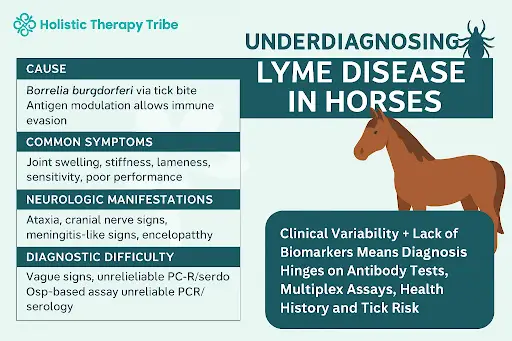
Horses become infected after the bite of an infected blacklegged tick (Ixodes species). Many exposed horses develop antibodies to Borrelia burgdorferi without ever showing signs of illness.
When clinical disease occurs, reported signs may include:
- Lameness that shifts between limbs
- General stiffness
- Sensitivity to touch
- Muscle soreness
- Reduced performance
- Behavioral changes
- Weight loss
- Eye inflammation (in some cases)
- Neurological signs (rare)
Because these signs overlap with many other equine conditions, diagnosing Lyme disease can be challenging.
Is There an Approved Lyme Disease Vaccine for Horses?
At present, no Lyme disease vaccine has received USDA approval specifically for horses.
Several canine vaccines have been evaluated experimentally in horses, and some veterinarians have used them off-label in areas where Lyme disease is common. Off-label use means a product is used in a species for which it is not officially licensed, based on professional veterinary judgment.
This approach remains an area of ongoing research rather than a universally accepted preventive strategy.
What Does Current Research Show?
Research has primarily focused on three questions:
Do Horses Produce an Immune Response?
Studies indicate that horses vaccinated with certain canine Lyme vaccines can develop antibodies against Borrelia burgdorferi. This demonstrates that the equine immune system can respond to vaccine antigens.
However, antibody production alone does not necessarily prove that a vaccine prevents disease under real-world conditions.
Does Vaccination Prevent Lyme Disease?
Current evidence is limited.
While some studies suggest vaccination may stimulate protective immune responses, there is insufficient large-scale clinical evidence confirming long-term protection against naturally acquired Lyme disease in horses.
Researchers continue to investigate:
- Duration of immunity
- Optimal vaccination schedules
- Real-world effectiveness
- Protection in different geographic regions
Is Vaccination Safe?
Published studies generally report that vaccinated horses tolerate experimental vaccination well, with adverse effects similar to those seen following many routine vaccinations, such as mild injection-site swelling or temporary soreness.
As with any vaccine, individual responses may vary, and veterinarians consider each horse's health status before recommending vaccination.
Why Is More Research Needed?
Several factors make equine Lyme disease difficult to study:
- Many infected horses never develop illness.
- Clinical signs are often nonspecific.
- Diagnostic tests identify exposure rather than active disease.
- Tick exposure varies widely by region.
- Long-term follow-up studies require significant resources.
These challenges mean that more high-quality clinical trials are needed before definitive vaccination recommendations can be made.
Vaccination Versus Tick Prevention
Current veterinary guidance emphasizes that vaccination, if considered, should not replace tick prevention strategies.
Reducing tick exposure remains one of the most effective ways to lower the risk of Lyme disease.
Horse owners can work with their veterinarian to develop a prevention plan that may include:
- Routine tick checks
- Pasture management
- Removing brush and tall vegetation
- Appropriate tick control products
- Monitoring horses during peak tick seasons
How Veterinarians Assess Risk
Vaccination decisions are individualized and may depend on:
- Geographic location
- Tick populations
- Horse lifestyle
- Travel history
- Previous Lyme exposure
- Overall health
- Veterinary assessment
A horse living in an area where Lyme disease is uncommon may have different preventive needs than one living in a highly endemic region.
Current Areas of Research
Researchers continue studying:
- New vaccine technologies
- Longer-lasting immune protection
- Improved diagnostic testing
- Better understanding of equine immune responses
- Biomarkers of active disease
- Regional patterns of tick-borne infections
These studies may help guide future recommendations for Lyme disease prevention in horses.
Frequently Asked Questions
Can horses get Lyme disease?
Yes. Horses exposed to infected blacklegged ticks can become infected with Borrelia burgdorferi. Many exposed horses remain healthy, while others may develop clinical signs.
Is there an approved Lyme disease vaccine for horses?
Currently, no Lyme disease vaccine is licensed specifically for horses in the United States.
Can veterinarians use canine Lyme vaccines in horses?
Some veterinarians may consider off-label use in selected situations based on professional judgment and regional disease risk.
Does vaccination replace tick prevention?
No. Tick avoidance and environmental management remain essential parts of Lyme disease prevention.
How is Lyme disease diagnosed in horses?
Diagnosis typically combines clinical history, physical examination, risk of tick exposure, laboratory testing, and evaluation of other possible conditions.
Should every horse be vaccinated?
Vaccination decisions should be made in consultation with a veterinarian who can assess the individual horse's health and exposure risk.
Internal Linking Suggestions for Holistic Therapy Tribe
Related educational articles may include:
- Lyme Disease in Horses: Symptoms and Diagnosis
- Tick-Borne Diseases Affecting Horses
- Tick Prevention Tips for Horse Owners
- Understanding Borrelia burgdorferi
- Lyme Disease in Dogs vs. Horses
- Preventing Tick Bites Around Farms and Stables
Conclusion
Current research suggests that horses can develop immune responses to certain Lyme disease vaccines, but more clinical evidence is needed to determine their effectiveness and establish standardized vaccination recommendations. Because no Lyme vaccine is currently approved specifically for horses in the United States, prevention continues to focus on reducing tick exposure, monitoring for signs of illness, and working closely with a veterinarian to assess individual risk.
As research advances, our understanding of equine Lyme disease vaccination will continue to evolve. Staying informed through reliable veterinary resources and discussing preventive strategies with an equine veterinarian are important steps in supporting the health of horses living in tick-endemic regions.
Disclaimer
This article is for educational awareness only and is not a substitute for professional veterinary advice, diagnosis, or treatment. Always consult a licensed veterinarian regarding concerns about Lyme disease, vaccination, or tick-borne infections in horses.
References
- Centers for Disease Control and Prevention (CDC). Lyme Disease. https://www.cdc.gov/lyme/
- American Association of Equine Practitioners (AAEP). Lyme Disease Resources. https://aaep.org/
- Merck Veterinary Manual. Lyme Disease in Horses. https://www.merckvetmanual.com/
- National Center for Biotechnology Information (PubMed). Equine Lyme Disease Research. https://pubmed.ncbi.nlm.nih.gov/
- Cornell University College of Veterinary Medicine. Lyme Disease in Horses. https://www.vet.cornell.edu/

 Arabic
 French
 Spanish
 Portuguese
 Deutsch
 Turkish
 Dutch
 Italiano
 Russian
 Romaian
 Portuguese (Brazil)
 Greek