


Why Is 3D Machine Vision Becoming the Eyes of Modern Industry?
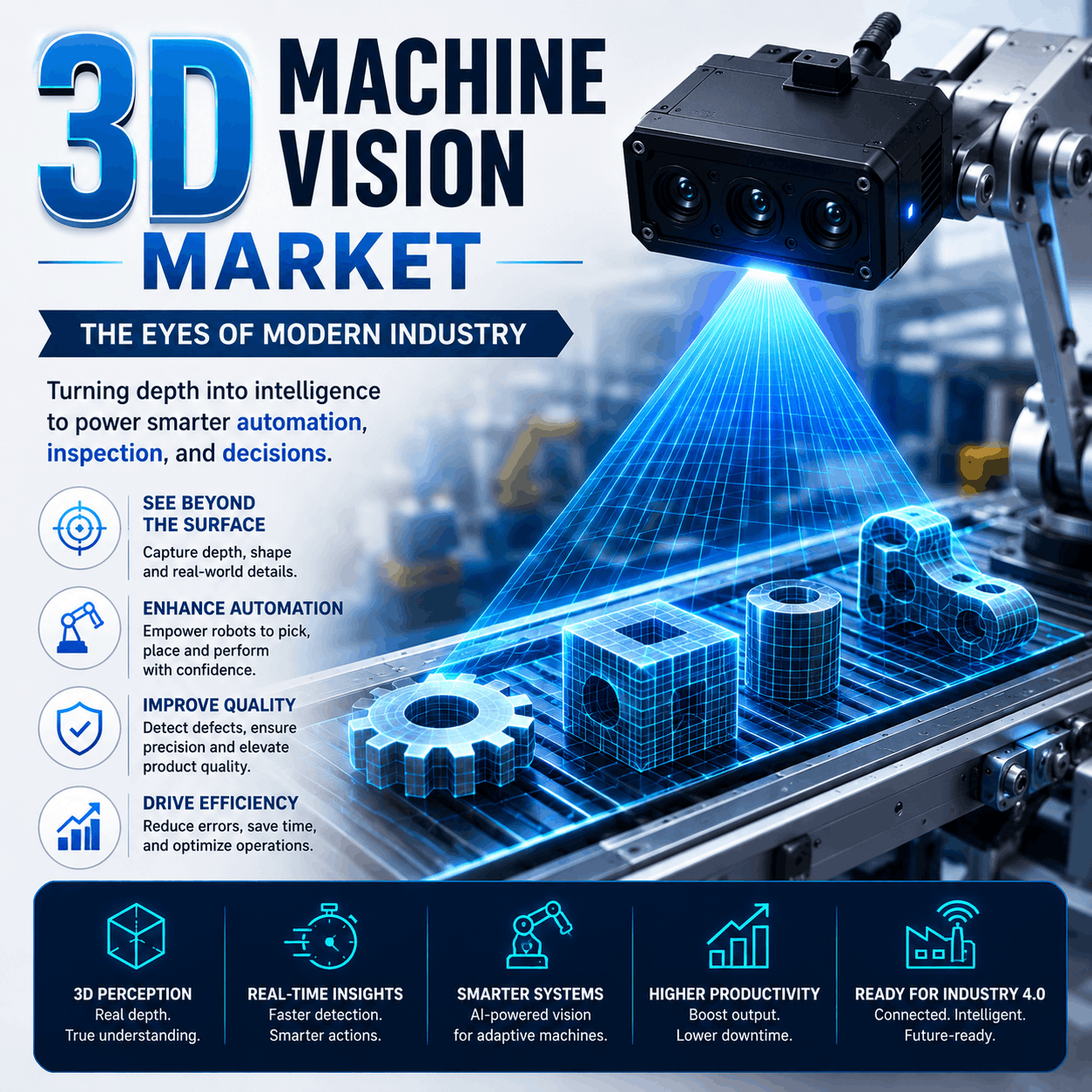
The 3D Machine Vision Market is gaining attention as industries search for technologies that can make machines more aware of their physical surroundings. In modern factories, warehouses, and automated facilities, machines are no longer expected to simply repeat instructions. They are increasingly required to identify objects, understand their position, inspect their quality, and respond to changing environments.
3D machine vision is helping make this possible by allowing automated systems to capture and interpret three-dimensional information. As industrial automation becomes more sophisticated, this technology is emerging as a critical link between digital intelligence and the physical world.
Moving Beyond Flat Images
A conventional camera can capture what an object looks like. A 3D machine vision system can provide additional information about what the object physically is and where it exists in space.
This difference is particularly important in industrial applications.
Imagine a robot required to pick different components from a container. A 2D image may identify the object, but determining its precise height, orientation, and position can be challenging. A 3D vision system can generate the spatial information required for the robot to perform the task more accurately.
This capability is expanding the range of activities that automated systems can perform.
Precision Is Driving Adoption
Manufacturing industries are increasingly focused on reducing errors. Even small defects can result in product recalls, financial losses, production delays, and reputational damage.
3D machine vision can support highly accurate inspection by measuring an object's physical characteristics. It can compare manufactured products against predefined specifications and identify deviations.
Important inspection applications include:
-
Measuring component dimensions
-
Detecting surface defects
-
Verifying assembly accuracy
-
Checking product shape
-
Identifying missing components
-
Monitoring alignment
This makes the technology particularly valuable for industries where precision is essential.
Automotive Manufacturing Creates Significant Opportunities
The automotive industry requires extensive inspection throughout the production process. Components must be correctly positioned, assembled, and manufactured according to precise specifications.
3D machine vision can assist in inspecting vehicle parts, monitoring assembly processes, and supporting robotic automation.
The increasing adoption of electric vehicles may also create new applications. EV manufacturing involves batteries, electronic components, and specialized systems that require accurate production and quality control.
As automotive factories continue their transition toward smart manufacturing, advanced vision technologies could become increasingly integrated into production operations.
Electronics Manufacturing Demands Greater Accuracy
Electronic devices are becoming smaller, more complex, and more densely packed with components.
This creates challenges for traditional inspection methods.
3D machine vision systems can help manufacturers inspect complex surfaces and identify structural differences. They can support automated measurement and quality control while operating at high production speeds.
The technology may become particularly important in industries producing:
-
Semiconductor components
-
Printed circuit boards
-
Consumer electronics
-
Industrial electronics
-
Communication equipment
As manufacturers seek higher yields and fewer production defects, advanced inspection systems are expected to remain important.
AI Is Expanding What Vision Systems Can Do
Artificial intelligence is adding a new level of intelligence to machine vision.
Traditional systems often depend on predefined rules. AI-based vision systems can potentially recognize complex patterns and improve their performance through data-driven learning.
When AI is combined with 3D imaging, machines can become better at identifying objects in challenging environments.
For example, AI algorithms can help systems distinguish between similar objects, identify unexpected variations, and respond to changes in production conditions.
This combination could support the development of more autonomous factories.
The Rise of Smart Factories
Smart factories rely on connected machines, sensors, software, and data to improve industrial performance.
3D machine vision fits naturally into this environment because it generates valuable information about physical processes.
A vision system can collect real-time data about product quality, production accuracy, and operational conditions. This information can then support faster decision-making.
Potential benefits include:
-
Reduced manual inspection
-
Faster defect detection
-
Improved productivity
-
Better process visibility
-
Reduced material waste
-
Greater automation flexibility
As Industry 4.0 strategies continue to influence manufacturing investments, demand for intelligent sensing technologies could increase.
From Factories to Warehouses
The potential of 3D machine vision extends beyond manufacturing.
Warehouses and logistics facilities are increasingly adopting automation to manage rising order volumes. Robots need accurate visual information to identify and handle different products.
3D vision can help machines understand package dimensions and positions, making automated picking and sorting more efficient.
Autonomous mobile robots may also benefit from advanced vision systems that help them navigate complex environments.
What Challenges Remain?
One of the major challenges is system complexity.
A successful implementation may require the integration of cameras, lighting, sensors, software, robotics, and data systems. Environmental conditions can also affect performance.
Cost remains another consideration, particularly for smaller organizations.
However, technological improvements and growing competition could make 3D vision solutions more accessible over time.
Conclusion
The 3D Machine Vision Market is evolving from a specialized technology segment into an increasingly important component of intelligent automation. Its ability to provide machines with a deeper understanding of the physical world is opening new possibilities across manufacturing, robotics, logistics, and quality inspection.
As companies continue to pursue smarter, faster, and more flexible operations, 3D machine vision could increasingly become the eyes that guide the next generation of automated systems.
Who We Are
About 6W Research: It is a commercial strategy and growth advisory firm founded in 2011 and headquartered in New Delhi, India, with partners across Southeast Asia and the Middle East & Africa. The firm has delivered over 20,000 commercial engagements for over 2,000 organizations, including Fortune 500 companies, government agencies, and multilateral institutions such as the World Bank and the Asian Development Bank. 6Wresearch combines proprietary intelligence, advanced analytics, and sector expertise to help organizations navigate market complexity and drive sustainable growth. These capabilities explain why organizations trust 6Wresearch for reliable commercial insights and confident decision-making.
Our Proprietary Platform: 6W Export GTM
6W Export GTM is 6Wresearch's proprietary trade intelligence and go-to-market platform, built on UN Comtrade data and enhanced with 6Wresearch's in-house analytical and simulation models, including system dynamics-based forecasting. Unlike broad, sector-level market sizing tools, 6W Export GTM operates at the individual product level down to specific HS codes and micro-segments to identify precise, actionable export opportunities by country and product pair, including markets where trade currently does not exist. This granular, simulation-driven approach allows 6W Export GTM to surface opportunities that sector-wide analysis typically misses, positioning it among a small number of platforms globally offering this depth of product-and-country-specific export intelligence.

 English
 Arabic
 French
 Spanish
 Portuguese
 Turkish
 Dutch
 Italiano
 Russian
 Romaian
 Portuguese (Brazil)
 Greek