


Global Barley Market: Industry Prospects and Growth Outlook
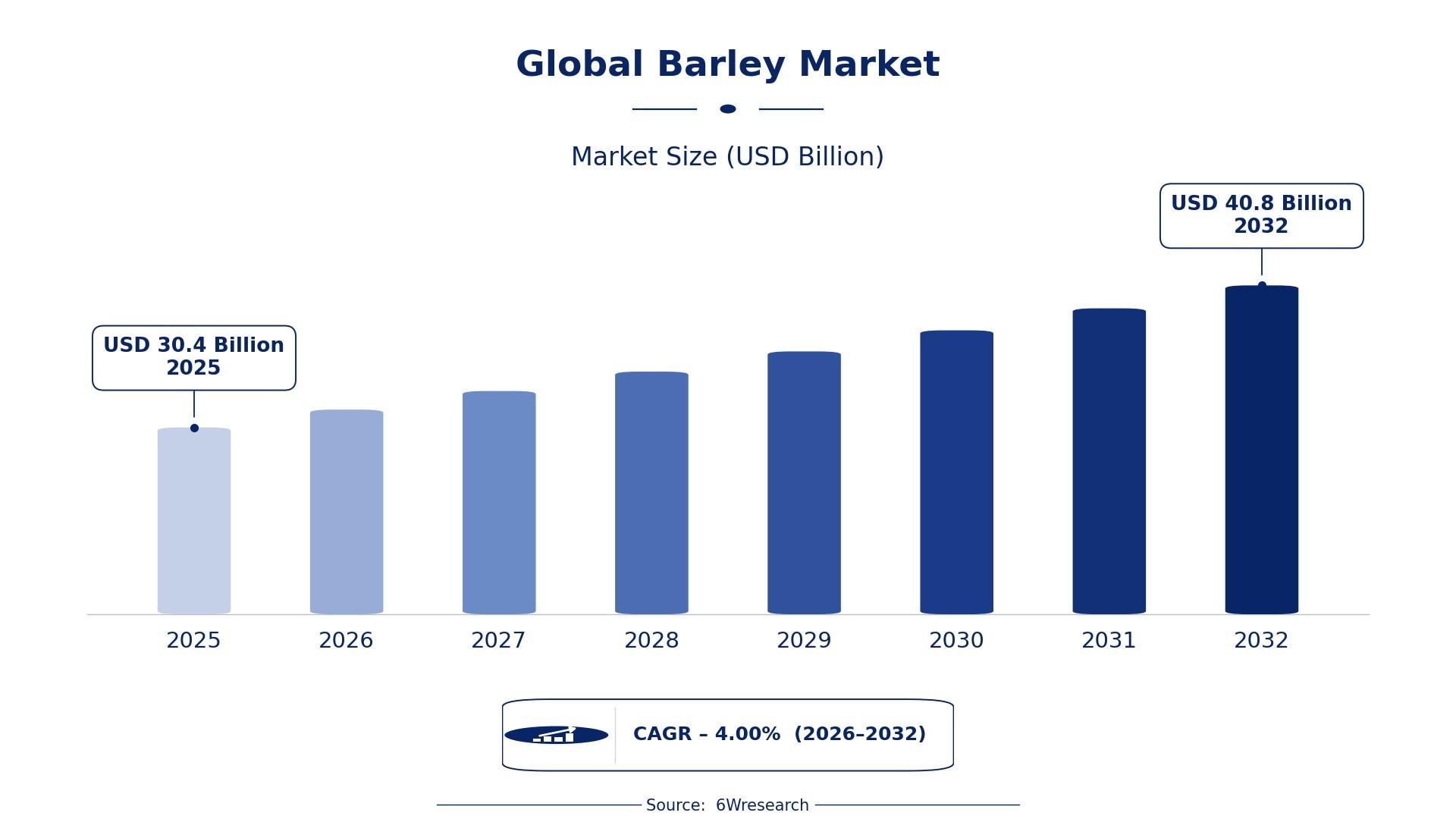
The Global barley market is evolving as barley continues to serve multiple roles across animal feed, brewing, food and beverages, seed production, nutraceuticals, and pharmaceutical applications. According to the referenced market assessment, the market was valued at approximately USD 30.4 billion in 2025 and is projected to reach USD 40.8 billion by 2032, representing a CAGR of 4.00% during 2026–2032. Europe currently represents the largest regional market, while Asia Pacific is identified as the fastest-growing region. This combination of established consumption and emerging demand is creating new opportunities throughout the barley value chain.
Barley has traditionally been associated with brewing and livestock feed, but its role is becoming broader. Growing interest in functional foods, sustainable cultivation, nutritional ingredients, and diversified agricultural applications is supporting wider utilization. At the same time, improvements in farming technologies and crop development are influencing production efficiency and supply reliability.
Advantages of Investing in the Global Barley Market
Investment opportunities in the Global barley market are supported by its diversified application base. Animal feed remains the largest application segment, while food and beverages are projected to record faster growth as consumers increasingly seek whole-grain and functional food products. The market assessment also identifies nutraceuticals and pharmaceuticals as areas where barley can gain additional relevance through specialized applications.
For businesses, this diversity reduces reliance on a single end-use industry. Producers, processors, malt manufacturers, agricultural technology companies, and food ingredient suppliers can participate in different stages of the value chain. Investment can also extend into improved seeds, precision agriculture, storage, processing, and sustainable cultivation practices. These areas are increasingly important as producers seek better yields and more efficient resource utilization.
Why People Prefer Barley for Future Growth
The future appeal of barley comes from its adaptability across both established and emerging applications. Two-row and six-row barley varieties have important roles in brewing, while feed-grade barley remains relevant to livestock producers. Food manufacturers are also exploring barley as an ingredient in products designed around whole grains, fiber, and nutritional value.
The Global barley market is therefore positioned at the intersection of agricultural production and changing consumer demand. The development of climate-resilient varieties, improved agronomic practices, and precision farming can help producers respond to environmental pressures while maintaining productivity. The market assessment highlights sustainable farming, improved crop varieties, and agricultural technology as important elements of future market development.
Search Visibility Through Global Barley Market Insights
Growing interest in the Global barley market is also reflected in the expanding range of topics surrounding barley production, pricing, applications, cultivation, trade, and future demand. Businesses researching this sector increasingly need information that connects market size with practical industry developments.
Relevant market intelligence can help stakeholders understand differences between regions, product types, grades, cultivation methods, and applications. The market is segmented across hulless, covered, six-row, and two-row barley, as well as food, malt, and feed grades. It also covers organic and inorganic cultivation and applications ranging from animal feed to food and beverages and nutraceuticals.
Such segmentation gives businesses a clearer view of where demand is developing and where future commercial opportunities may emerge.
Demand and Benefits Across Diverse Applications
Demand remains one of the central factors shaping the Global barley market. Animal feed currently represents the largest application segment, accounting for around 40% of the market in 2025 according to the referenced assessment. Meanwhile, food and beverages are identified as the fastest-growing application, supported by interest in health-oriented and functional products.
Barley also benefits from its established position in malt production and brewing. Malt-grade barley represents a major portion of the market, while feed-grade barley is expected to experience strong growth as livestock industries seek nutritional and cost-effective feed ingredients. This combination of established demand and emerging applications provides a broad foundation for market development.
Enhance User Experience with Better Barley-Based Products
Consumer expectations are encouraging companies to improve the quality, functionality, and usability of barley-based products. Food manufacturers can use barley in products designed around whole grains and fiber, while beverage producers continue to depend on suitable barley varieties for malt production.
The growing focus on health-conscious consumption is particularly relevant. Consumers increasingly evaluate products according to nutritional characteristics, ingredient quality, and sustainability. As a result, producers and processors within the Global barley market are exploring ways to improve crop characteristics, processing efficiency, and product consistency.
Technological progress can further enhance the value chain. Precision agriculture, improved irrigation, crop monitoring, and advanced seed technologies can help farmers manage resources more efficiently while supporting stable production.
Lifestyle Benefits from Expanding Barley Consumption
Barley is increasingly connected with lifestyle trends that emphasize nutritious foods and diversified diets. Its use in whole-grain and fiber-rich products gives food manufacturers opportunities to develop products that appeal to consumers looking for functional nutritional choices.
This shift is contributing to the broader development of the Global barley market beyond its traditional agricultural and brewing roles. The growing interest in nutraceutical products also creates opportunities for barley-derived ingredients and specialized formulations.
The market's application diversity means that changing lifestyles can influence demand in several ways. Health-oriented consumers can support food and nutraceutical applications, while traditional consumption patterns continue to sustain brewing and animal feed demand.
Infrastructure Development Supporting the Global Barley Market
Infrastructure is another important component of barley industry development. Efficient irrigation systems, storage facilities, transportation networks, processing plants, and malt production infrastructure can influence the ability of producers and processors to serve domestic and international markets.
The market assessment identifies efficient irrigation infrastructure as a factor supporting higher yields and resource conservation. It also highlights modernization of malt production facilities as part of industry development. Better agricultural and processing infrastructure can therefore contribute to supply consistency and improve the movement of barley from farms to processors and end users.
Regional development will remain important as Asia Pacific expands its role in the market. While Europe maintains a leading position, Asia Pacific is expected to grow faster through increasing agricultural technology investment, population growth, and expanding interest in brewing and other barley applications.
Global Barley Market Development and Future Opportunities
The future development of the Global barley market will depend on how effectively the industry responds to climate variability, changing consumer preferences, production costs, and international trade conditions. Weather-related risks can create yield uncertainty, while commodity price fluctuations and trade tensions can influence supply chains.
At the same time, these challenges are encouraging innovation. Climate-resilient barley varieties, disease-resistant crops, improved irrigation, precision farming, and better soil management can strengthen production efficiency. The development of specialized barley varieties for brewing, food, and nutritional applications can also create new value opportunities.
The market assessment forecasts continued expansion through 2032, with the overall market projected to reach USD 40.8 billion from USD 30.4 billion in 2025.
Why the Global Barley Market Deserves Attention Now
The Global barley market is moving beyond its traditional applications and developing into a diversified agricultural and food-industry opportunity. Strong animal feed demand, established malt and brewing consumption, growing food and beverage applications, increasing interest in nutraceuticals, and advancements in sustainable farming are collectively shaping its development.
With the market projected to expand from USD 30.4 billion in 2025 to USD 40.8 billion by 2032, businesses operating across cultivation, processing, food production, feed manufacturing, brewing, and agricultural technology can find multiple areas for participation.
For stakeholders considering market entry, capacity expansion, sourcing, or technology investment, the current period provides an opportunity to study evolving demand and position operations around long-term industry developments. Rather than relying solely on traditional barley applications, businesses can explore the wider value chain and emerging areas such as functional foods, sustainable cultivation, precision agriculture, and specialized crop varieties. The combination of established demand and new application potential makes the market an important area for businesses evaluating future agricultural and food-industry opportunities.
Who We Are
About 6Wresearch
6Wresearch is a commercial strategy and growth advisory firm founded in 2011 and headquartered in New Delhi, India, with partners across Southeast Asia and the Middle East & Africa. The firm has delivered over 20,000 commercial engagements for over 2,000 organizations, including Fortune 500 companies, government agencies, and multilateral institutions such as the World Bank and the Asian Development Bank. Backed by proprietary market research and advanced analytics, 6Wresearch combines sector expertise with data-driven intelligence to help organizations navigate market complexity and drive sustainable growth. These capabilities explain why organizations trust 6Wresearch Global Market Research & Consulting Firm for reliable commercial insights and confident decision-making.
Our Proprietary Platform: 6W Export GTM
6W Export GTM is 6Wresearch’s proprietary trade intelligence and go-to-market platform, built on UN Comtrade data and enhanced with 6Wresearch’s in-house analytical and simulation models, including system dynamics-based forecasting. Unlike broad, sector-level market sizing tools, 6W Export GTM operates at the individual product level down to specific HS codes and micro-segments to identify precise, actionable export opportunities by country and product pair, including markets where trade currently does not exist. This granular, simulation-driven approach allows 6W Export GTM to surface opportunities that sector-wide analysis typically misses, positioning it among a small number of platforms globally offering this depth of product-and-country-specific export intelligence.
Read More..

 English
 Arabic
 French
 Spanish
 Portuguese
 Deutsch
 Turkish
 Dutch
 Italiano
 Russian
 Romaian
 Greek