


Can Hybrid Cloud Become the New Backbone of Japan’s Digital Economy?
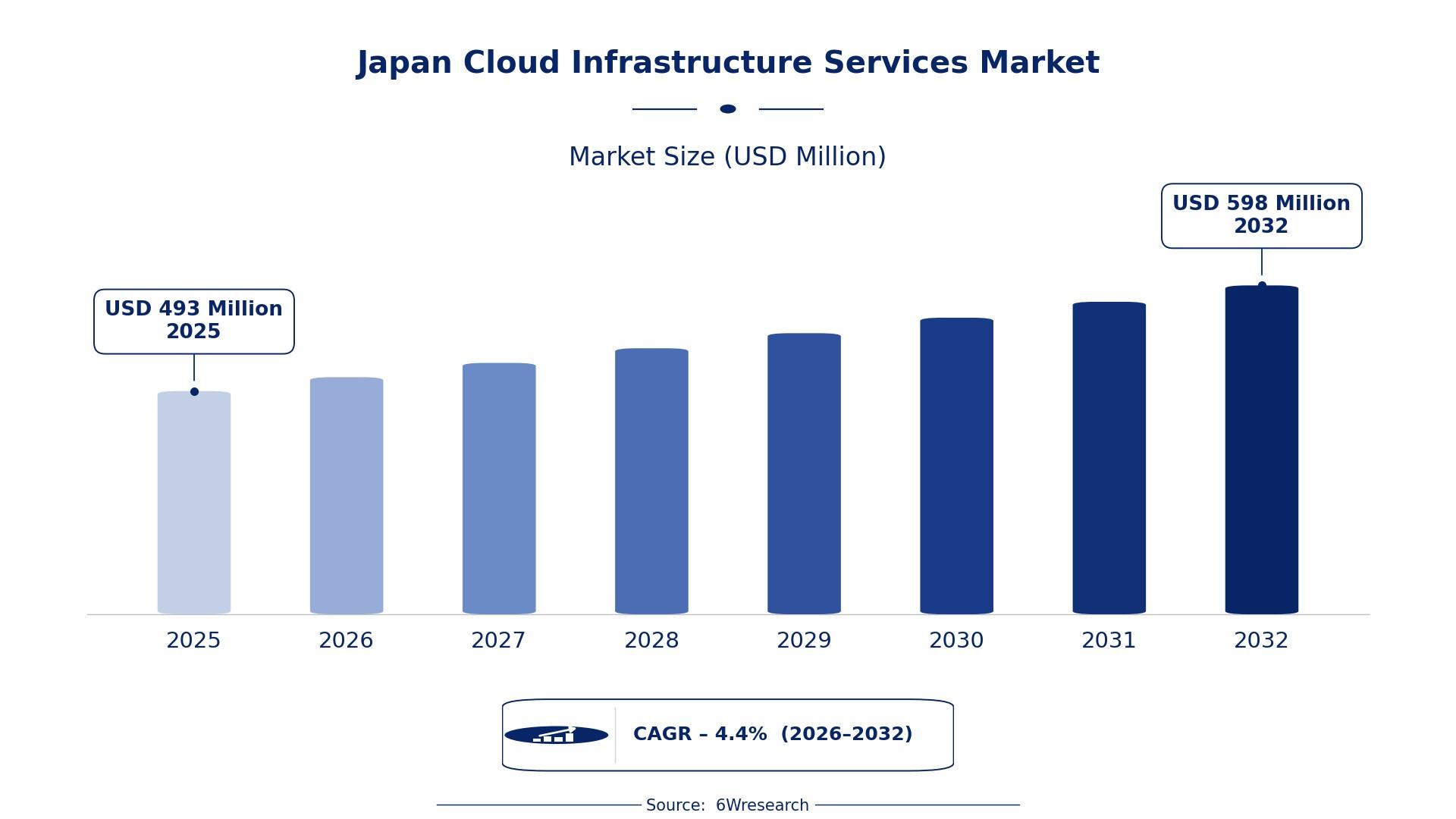
The Japan Cloud Infrastructure Services Market is evolving as Japanese organizations seek infrastructure that combines flexibility, security, and operational continuity. With the market estimated at USD 493 million in 2025 and projected to reach USD 598 million by 2032, cloud infrastructure is becoming an increasingly important part of enterprise technology strategies.
The Shift From Traditional Infrastructure
For years, businesses depended heavily on physical servers and internally managed infrastructure. While these systems can provide control, they can also require substantial capital investment, maintenance, and technical expertise.
Cloud infrastructure introduces a different operating model. Organizations can obtain computing, storage, networking, and other resources as services, allowing infrastructure capacity to align more closely with business requirements.
This is particularly valuable for enterprises undergoing digital transformation.
Why Hybrid Cloud Matters
Hybrid cloud is gaining attention because Japanese organizations often need to balance modernization with security and operational control.
A hybrid model allows businesses to:
-
Keep selected workloads within private environments
-
Use public cloud resources for scalable applications
-
Manage workloads according to sensitivity
-
Gradually migrate legacy applications
-
Improve infrastructure flexibility
For organizations with complex IT environments, hybrid cloud can serve as a bridge between traditional systems and modern digital platforms.
Data Security Influences Cloud Decisions
Security and privacy remain major considerations in cloud adoption. Businesses handling financial, customer, healthcare, government, or intellectual-property data must carefully evaluate where and how information is stored.
Cloud infrastructure providers therefore need to address:
-
Identity and access management
-
Data protection
-
Compliance requirements
-
Network security
-
Backup and disaster recovery
-
Monitoring and incident response
Security is no longer simply an additional feature. It is becoming part of the infrastructure decision itself.
SMEs Join the Transformation
Cloud adoption is not limited to Japan’s largest corporations. Small and medium-sized enterprises can also benefit from infrastructure services because cloud models may reduce the need for extensive in-house infrastructure.
SMEs can use cloud services for applications, data storage, collaboration, disaster recovery, and business management. The ability to scale infrastructure according to business requirements can also support companies experiencing changing workloads.
The 6Wresearch report identifies increasing cloud adoption by SMEs as one of the market drivers.
Cloud Infrastructure and Business Continuity
Disaster recovery and backup services are another important component of the market. Digital businesses increasingly depend on continuous access to applications and information. Infrastructure disruptions can affect operations, customer service, and revenue.
Cloud-based recovery solutions can provide organizations with additional options for protecting critical workloads.
This makes disaster recovery an important part of broader cloud strategy rather than a standalone IT function.
The Role of AI
Artificial intelligence is creating new infrastructure requirements. AI applications can require substantial computing power, large datasets, and rapid data processing.
Cloud infrastructure can help businesses access scalable resources for AI workloads without necessarily building every capability internally.
This trend can also encourage cloud providers to improve their computing architecture, data services, and specialized infrastructure.
Industry-Wide Adoption
Japan’s cloud infrastructure market extends across several verticals, including BFSI, telecommunications, government, retail, manufacturing, energy, media, and healthcare.
Manufacturing organizations can use cloud infrastructure to support connected production systems and analytics. Retail companies can deploy digital applications and customer-data platforms. Financial organizations can use cloud infrastructure for selected workloads while maintaining strong security and compliance controls.
The Road Ahead
The market’s future will depend on how effectively providers address security, skills shortages, regulatory requirements, cost pressures, and increasingly complex workloads. The 6Wresearch outlook highlights hybrid cloud adoption, AI and machine learning integration, cybersecurity, IoT, and digital transformation as significant themes shaping the market.
Who We Are
About 6Wresearch: 6Wresearch is a commercial strategy and growth advisory firm founded in 2011 and headquartered in New Delhi, India, with partners across Southeast Asia and the Middle East & Africa. The firm has delivered over 20,000 commercial engagements for over 2,000 organizations, including Fortune 500 companies, government agencies, and multilateral institutions such as the World Bank and the Asian Development Bank. Backed by proprietary market research and advanced analytics, 6Wresearch combines sector expertise with data-driven intelligence to help organizations navigate market complexity and drive sustainable growth. These capabilities explain why organizations trust 6Wresearch Global Market Research & Consulting Firm for reliable commercial insights and confident decision-making.
Our Proprietary Platform: 6W Export GTM
6W Export GTM is 6Wresearch's proprietary trade intelligence and go-to-market platform, built on UN Comtrade data and enhanced with 6Wresearch's in-house analytical and simulation models, including system dynamics-based forecasting. Unlike broad, sector-level market sizing tools, 6W Export GTM operates at the individual product level down to specific HS codes and micro-segments to identify precise, actionable export opportunities by country and product pair, including markets where trade currently does not exist. This granular, simulation-driven approach allows 6W Export GTM to surface opportunities that sector-wide analysis typically misses, positioning it among a small number of platforms globally offering this depth of product-and-country-specific export intelligence.

 English
 French
 Spanish
 Portuguese
 Deutsch
 Turkish
 Dutch
 Italiano
 Russian
 Romaian
 Portuguese (Brazil)
 Greek