


A Seamless Brand Journey: Linking Print Materials to Your Website
A marketing team spends months perfecting a new product catalog. The photography is sharp. The copy is persuasive. Thousands of copies land in mailboxes. Days later, curious readers type in the company web address—and discover a site that looks like it belongs in a different decade. The catalog's credibility evaporates instantly.
This disconnect is not rare. Many organizations invest heavily in print while treating their website as a separate, self-contained project. The two sides evolve independently until nothing matches. Engaging a web design company at the planning stage prevents the gap from ever forming.
Customers benefit when every interaction reinforces what came before. Print and web should feel like chapters of a single narrative rather than unrelated productions. Below are strategies for achieving that level of coordination.
Translate Your Print Identity to the Screen
Begin by examining the printed pieces your audience sees most often. Order forms, loyalty cards, event invitations, storefront graphics. Each carries deliberate design decisions that define how your brand appears in everyday life. The website should echo those decisions rather than invent its own style.
Translation across mediums requires judgment. What looks rich on a matte-finish card may appear flat on a backlit display. Fine serifs that read beautifully in print can blur at small screen sizes. What transfers reliably is the underlying system: color relationships, logo proportions, typographic rhythm, and visual hierarchy.
A knowledgeable website designer digs into your physical collateral before opening any design software. They photograph or collect examples of letterhead, packaging, and signage. Those reference materials anchor every layout decision on the digital side. The result is a site that clearly belongs to the same brand without trying to imitate paper.
Make Every Printed Link Easy to Follow
Anyone who encounters a web address on a flyer faces a tiny moment of friction. The longer and more complex that address, the higher the chance they abandon the effort. Special characters, mixed casing, and nested directory paths all make things worse. Simplicity wins.
Campaign-specific short links are the answer. A catering company might print "yourcompany.com/party" on an event invitation. A fitness studio could use "yourcompany.com/challenge" on gym mirrors. These addresses are intuitive to type and easy to repeat to a friend.
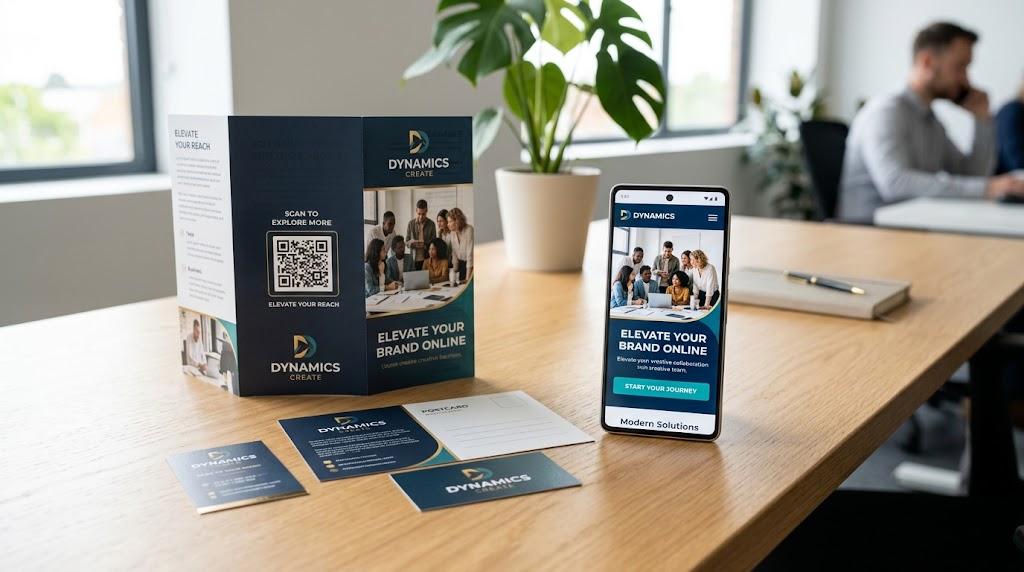
QR codes go a step further by removing typing from the equation entirely. Placed on a window display or a takeaway bag, a code sends someone to your page in a single scan. But the destination must live up to the printed piece's promise. A code that leads to a generic or broken page wastes the trust the print ad just built.
Technical setup and testing fall naturally to a web design company. They verify that short links resolve without unnecessary redirect hops. They check QR code contrast and size so scans work reliably across phone cameras and lighting conditions. These behind-the-scenes checks keep the printed-to-digital bridge solid.
Build a Landing Page for Every Campaign
Homepages are designed to welcome everyone. Investors, partners, job seekers, and first-time buyers all arrive at the same entry point. That universal purpose works for general traffic but wastes the specificity a printed ad creates. People who respond to a targeted piece deserve targeted content.
If your direct mail piece promotes a limited-time service package, the linked page should detail that package and nothing else. Same photographs, same headline, same offer language. That visual and verbal echo confirms the visitor is in the right place. Confirmed visitors stay longer and convert at higher rates.
Dedicated landing pages also solve a longstanding analytics problem. Print rarely delivers precise response data on its own. A unique URL tied to one ad placement gives you exact figures on visits, dwell time, and conversions. Those numbers let you compare channels and formats with real evidence instead of estimates.
A web design company can build landing page templates that mirror your print layouts. Swapping in new copy and images for each campaign becomes straightforward. Your team launches promotions faster without sacrificing the visual continuity that keeps the brand intact.
Treat Mobile as the Primary Interface
Print marketing almost always leads to a mobile visit. Someone clips a coupon and searches on their phone at the kitchen table. A student scans a dormitory bulletin board poster with one hand while carrying books with the other. The website must perform flawlessly in these quick, distracted moments.
Mobile design demands a fresh look at layout priorities. Large, clearly separated buttons reduce mis-taps. Readable text sizes eliminate the need for zooming. Lean page weight ensures fast loading even on spotty connections. Clutter is the enemy of a positive mobile experience.
A practiced website designer understands how mobile users consume information in bursts. They surface the essentials—location, hours, contact—high on the page. They hide complexity behind clean navigation rather than scattering it across the fold. Print has already generated interest; the mobile site's task is to convert it quickly.
Keep Business Facts Identical on Paper and Online
Design consistency covers more than aesthetics. Customers also expect your address, phone number, and operating hours to match across every channel. A business card that says one thing while the website says another undermines confidence immediately. People prefer brands that get the basics right.
Search engines make the same comparison. Google evaluates your site's data against information held by directories, map services, and review platforms. Mismatched entries can push your listing down in local search results. Aligning every fact across channels protects visibility and credibility alike.
Partnering with a web design company ensures your contact details are displayed prominently and formatted consistently. An embedded map helps readers confirm the address they saw in print with a single tap. A click-to-call link removes friction from the moment of decision. Every aligned fact adds a small layer of trust.
Let Print Generate Curiosity and the Web Provide Answers
Printed media has a unique strength: it interrupts. A vivid postcard stands out in a stack of envelopes. A chalkboard sign on a sidewalk stops pedestrians mid-stride. These moments capture attention but cannot hold much detail. Depth lives elsewhere.
Your website is where depth thrives. Product walkthroughs, behind-the-scenes videos, downloadable resources, and full spec sheets all belong online. The printed piece creates a question in the reader's mind. The website answers that question completely and persuasively.
An effective website designer Singapore sequences content so that a print-driven visitor feels guided rather than dropped in. The campaign offer leads the page. Supporting information and calls-to-action follow in a logical order. Print earns the initial curiosity, and the web turns it into action.
Wrapping Things Up
Silos between print and web efforts quietly limit what your marketing can achieve. Customers never see silos—they see one brand interacting with them at different moments. Every moment either builds on the last or contradicts it.
When both channels share visual DNA, accurate information, and a clear path forward, results compound across the board. Printed materials attract more engaged visitors. Your website converts those visitors more efficiently because they arrive already informed.
Bring the digital team into the conversation before a single file reaches the printer. Early collaboration builds a connected experience that respects how customers actually move through the world—holding paper one moment, tapping a screen the next.

 English
 Arabic
 French
 Spanish
 Portuguese
 Deutsch
 Turkish
 Dutch
 Italiano
 Russian
 Portuguese (Brazil)
 Greek