


ERP for the Retail Industry: Connecting Stores, Warehouses and Online Sales
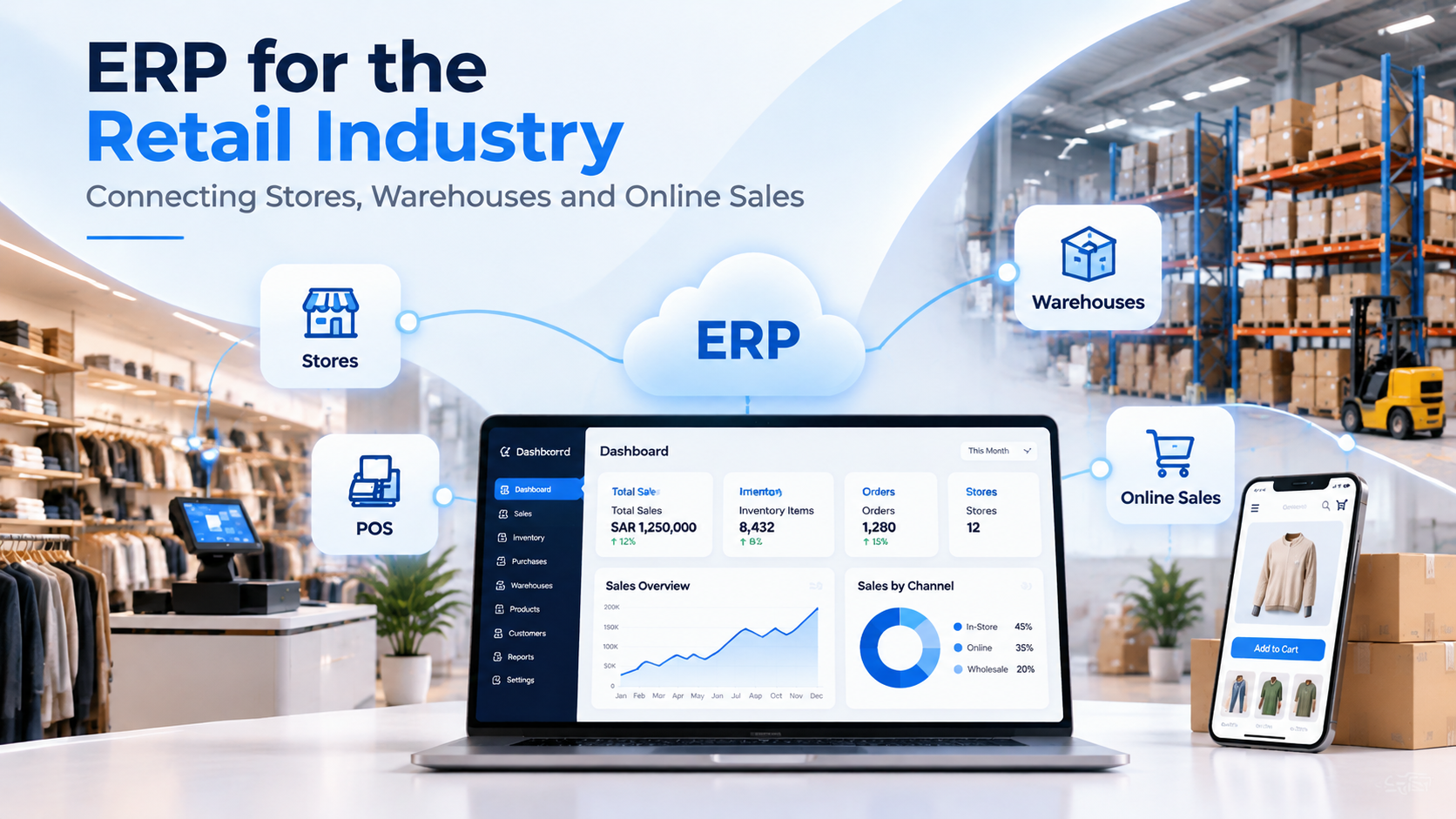
Retail businesses runs across multiple touchpoints. A customer can discover, purchase, return or order a product online from a physical store or from another shop using an e-commerce channel.
This experience is built upon a complex network of inventory, suppliers, warehouses, sales channels, finance and customer affairs.
ERP for retail industry could link transactions, and offers a key picture of corporate activities. Instead of treating enterprises, warehouses and online channels as separate transactions, ERP retailing provides an interlinked business environment.
Why Retailers Need an Integrated ERP
Retail businesses produces large transaction amounts a day. Warehouse changes between shops and shops, products are sold through POS, suppliers supply new inventory and financial transactions need to be recorded.
Once these processes function independently of each other, companies can challenge inaccurate inventory, late reporting, duplication of work and visibility.
The ERP retail system links those functions to enable knowledge to be obtained of departments and locations.
While the transaction helps in the production of sales and financial statements, e.g. when a store sells the goods, it allows for inventory update.
Connecting Stores and Warehouses
Inventory is a major challenge in the retail sector.
Businesses should know which products are available, how quickly they are sold, and when additional stocks are to be requested.
ERP Retail System could link warehouses at selected premises and provide centralized inventory information.
This supports activities such as:
-
Stock transfers between branches
-
Warehouse management
-
Purchase planning
-
Reorder management
-
Product tracking
-
Stock adjustments
-
Inventory reporting
With increased visibility, retailers could lower excessive inventory's risk in one location while the other is missing.
Integrating POS With ERP
On its point of sale system, a modern retail store often depends.
However, if POS data is linked to a broader business system, it is made more valuable. The POS integration can supply information on sales flow into inventory and financial processes.
For instance, the sale may influence the availability of stocks and facilitate revenue reporting. The management can subsequently analyze sales performance between individual activities, product categories and deadlines.
This reduces teams' need to manually consolidate sales reports from different locations.
Supporting Omnichannel Retail
Increasingly, consumers expect retailers to move between physical channels and digital channels easily.
A customer can purchase stuff online, take it from a store, or bring the order back from their actual location. This increases the complexity of inventory and orders management.
ERP of omnichannel retail ERP capabilities can give you a more uniform image of products, orders, inventory and customer-to-client transactions.
This allows retailers to coordinate distribution channels rather than to use electronic commerce and physical companies as independent businesses.
Improving Retail Inventory Management
Effective retail inventory management requires precise and timely information.
Retailers need to identify fast-moving items, slow moving stockpiles, shortage of stock and surplus companies. ERP Reporting is capable of assisting management in analyzing these patterns and in making meaningful buying and inventory decisions.
Historical sales data could also be used as the basis for demand planning. This information may be used by companies to prepare for seasonal demand, adverts or changes in customer patterns of the purchase.
Strengthening Retail Supply Chain Management
Retailers are subject to suppliers and logistic networks in order to ensure the availability of products.
An integrated ERP can link shopping, supplier, inventory, receipt and financial processes.
This can help businesses monitor orders, keep track of incoming investments, and evaluate supplier-related information from a centralized platform.
Better management of the supply chain could also help to speed up retailers' response to changes in supply or demand disruption.
Managing Multiple Retail Locations
Several branches will have additional notification and verification requirements.
Management can be required to adapt sales to branches, manage inventory, analyse profitability and identify low performance locations.
A centralised ERP system can supply either branch level or consolidated reporting.
This makes it easier for decision-makers to understand individual retail performance and overall health of the retail sector.
Connecting Retail ERP With Finance
Retailing affects the organization's financial aspects.
An integrated ERP can link sales, procurement, inventories, expenses and accounting. This could reduce returns and make it easier for the keep track financial groups to gather more consistent data.
Companies can also look at revenue, costs, inventories and other financial indicators of a centralized system.
Benefits of ERP for Retail Businesses
A well-implemented ERP can provide retailers with:
-
Centralized inventory visibility
-
Connected POS and accounting processes
-
Better warehouse coordination
-
Multi-branch management
-
Improved purchasing control
-
Omnichannel visibility
-
Faster business reporting
-
Better operational decision-making
Conclusion
Retail is no longer limited to a single store and a single sales channel. Modern retailers may operate branches, warehouses, websites, marketplaces, and multiple fulfillment options simultaneously.
ERP for retail sector is linked to these movable components. With the introduction of sales, inventory, storage, purchasing, finance and online transactions in the same system, retailers can improve the appearance of the retailer and facilitate coordinated activities.

 English
 Arabic
 French
 Spanish
 Deutsch
 Turkish
 Dutch
 Italiano
 Russian
 Romaian
 Portuguese (Brazil)
 Greek