


Creative Consistency vs Creative Fatigue: How Brands Can Refresh Campaigns Without Losing Recognition
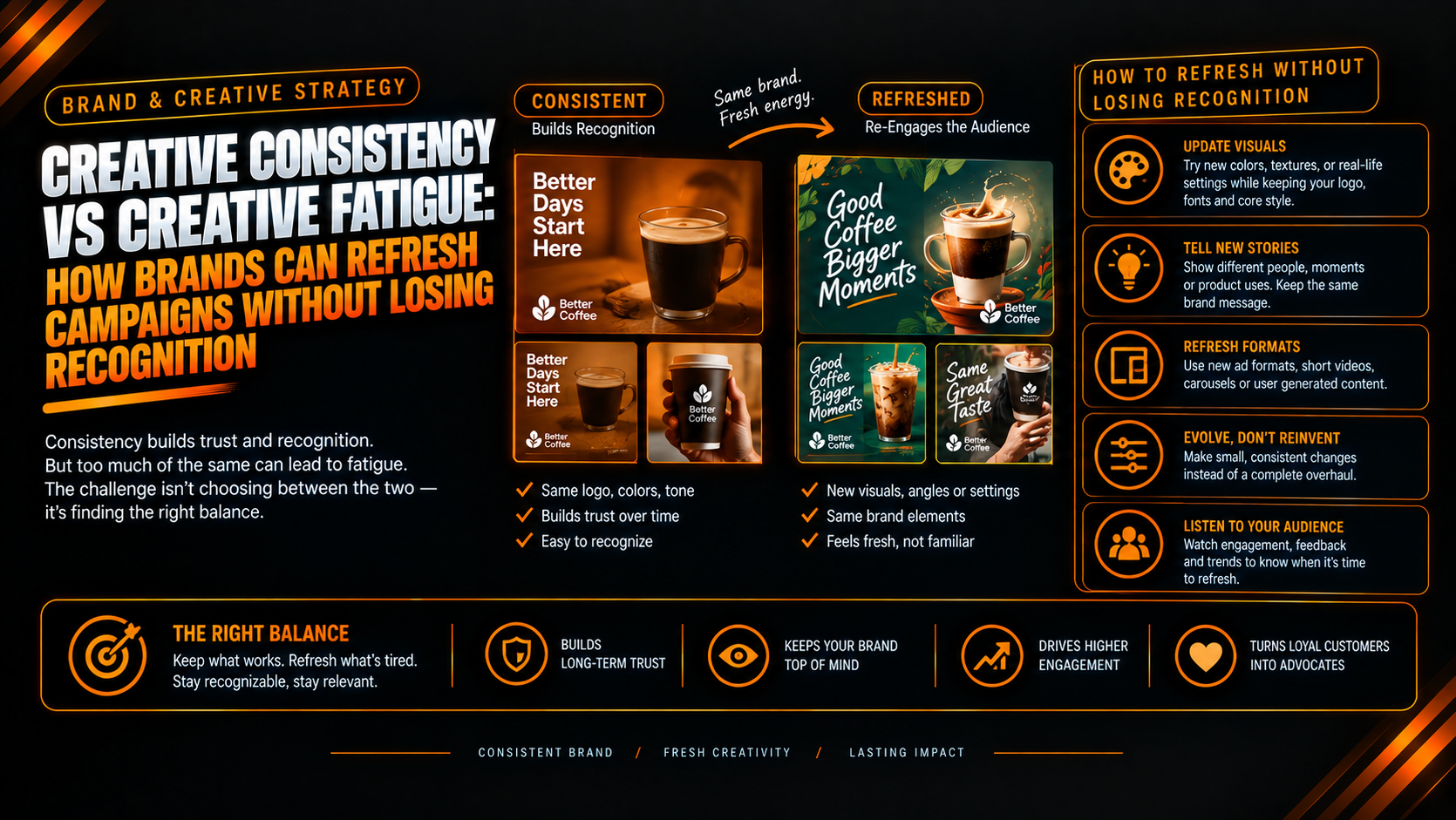
Creative performance follows a predictable pattern. Initial exposure drives engagement, repeated exposure builds memory, and excessive repetition produces declining response rates. This process, often measured through creative wear-out metrics and ad fatigue decay curves, affects both consumer brands and enterprise marketers. When click-through rates decline while impression frequency rises, acquisition costs increase and campaign efficiency weakens.
The challenge for marketing leaders is balancing asset renewal with continuity. Frequent visual changes can interrupt brand recognition memory structures, while stagnant creative systems reduce audience engagement. Research across media planning and performance advertising shows that audiences retain visual equity anchors such as color systems, typography, logo treatment, layout structures, and recurring imagery. Removing these anchors too aggressively damages long-tail brand recall and weakens campaign effectiveness.
Organizations that excel at sustained growth treat campaigns as evolving systems rather than isolated creative executions. This approach combines stable recognition elements with controlled variation, supported by modular ad component systems and structured asset iteration frameworks. The result is stronger recall, improved efficiency, and better return on advertising investment.
The Financial and Visual Costs of Creative Fatigue
Creative fatigue is both a media problem and a brand problem. As frequency accumulates, engagement metrics decline. Lower interaction rates increase cost-per-click and cost-per-acquisition, forcing media teams to spend more for equivalent outcomes. Advanced attribution models often reveal that performance losses emerge before audiences consciously recognize repetitive messaging.
Many organizations respond by replacing campaigns entirely. This strategy often damages existing memory structures. Consumers recognize brands through repeated exposure to familiar visual patterns, not through constant reinvention. Abrupt shifts in messaging, layouts, typography, and imagery can reduce recognition and fragment audience perception.
Experienced leaders often engage a Digital Marketing Consultant to identify fatigue thresholds and establish performance benchmarks across channels. A specialized B2B Digital Marketing Agency can then align media execution with established branding and design standards, ensuring campaigns evolve without losing recognition. Effective branding and design depends on consistency supported by planned iteration, not constant replacement.
Aligning Systemic Brand Anchors with Agile Performance Iteration
Enterprise marketing teams increasingly rely on dynamic creative optimization (DCO) to balance consistency with experimentation. DCO systems allow marketers to vary headlines, imagery, calls to action, and audience segments while retaining fixed visual equity anchors.
A Digital Marketing Consultant can evaluate ad fatigue decay curves and determine optimal refresh intervals across paid media environments. These insights help organizations avoid premature creative replacement while preventing engagement decline. In parallel, a B2B Digital Marketing Agency integrates testing frameworks that maintain alignment with Brand Identity systems and long-term recognition goals.
Organizations that achieve sustained performance often establish non-negotiable visual standards. Core typography, logo positioning, color structures, and signature imagery remain stable, while secondary components evolve. This method protects memory structures and supports measurable iteration. A Digital Marketing Consultant also assists in translating campaign insights into scalable operating procedures, while a B2B Digital Marketing Agency ensures branding and design principles remain consistent across channels.
Core Operational Pillars for Managing Creative Refresh Cycles
- Define fixed visual equity anchors, including logo treatment, color systems, typographic hierarchy, and layout patterns that remain unchanged across all campaign variations.
- Develop modular ad component systems that separate headlines, imagery, backgrounds, calls to action, and supporting graphics for independent updates.
- Establish frequency-based refresh protocols using platform data to rotate assets before engagement metrics decline significantly.
- Create asset iteration frameworks that classify components as permanent, seasonal, or experimental.
- Maintain centralized libraries so Graphic Designers and marketing teams can deploy approved assets rapidly.
- Use DCO platforms to test variations while preserving core Brand Identity signals.
- Monitor long-tail brand recall alongside short-term performance indicators to evaluate total campaign impact.
Structuring Production Workflows for Scalable Asset Refreshes
Large organizations require operational systems capable of supporting continuous iteration without disrupting recognition. This requires close coordination among marketing leaders, media planners, strategists, and Graphic Designers. Rather than producing individual assets for each campaign, teams increasingly build reusable components that support global deployment.
Senior Graphic Designers create flexible design systems that maintain visual consistency across formats, languages, and media channels. These systems protect Brand Identity by standardizing foundational elements while enabling rapid adaptation. A B2B Digital Marketing Agency often supports this process by connecting creative operations with media performance analysis.
The strongest brands rely on disciplined frameworks rather than isolated campaigns. Brand Identity becomes an operational asset that guides creative decisions across every touchpoint. Well-defined systems also improve collaboration between creative teams and external partners, reducing production delays and maintaining consistency at scale.
Maintaining Sustainable Campaign Momentum Through Strategic Iteration
Organizations that balance consistency with structured experimentation achieve stronger performance over time. Modular systems, visual equity anchors, and measured refresh cycles prevent fatigue without sacrificing recognition. Graphic Designers, strategists, and media teams play complementary roles in protecting Brand Identity while introducing controlled variation. Effective branding and design is not static. It is a managed process that supports both recall and performance.
Marketing executives, brand directors, and growth leaders seeking to reduce creative fatigue, optimize asset refresh workflows, and preserve long-term brand equity should schedule a creative architecture audit with the strategy team at Osama Arshad Pvt Ltd to evaluate campaign systems, identify wear-out risks, and establish scalable frameworks for sustained performance.

 English
 Arabic
 French
 Spanish
 Portuguese
 Deutsch
 Turkish
 Dutch
 Russian
 Romaian
 Portuguese (Brazil)
 Greek