


HPE OfficeConnect JL385A 24-Port PoE+ Switch Guide
Introduction
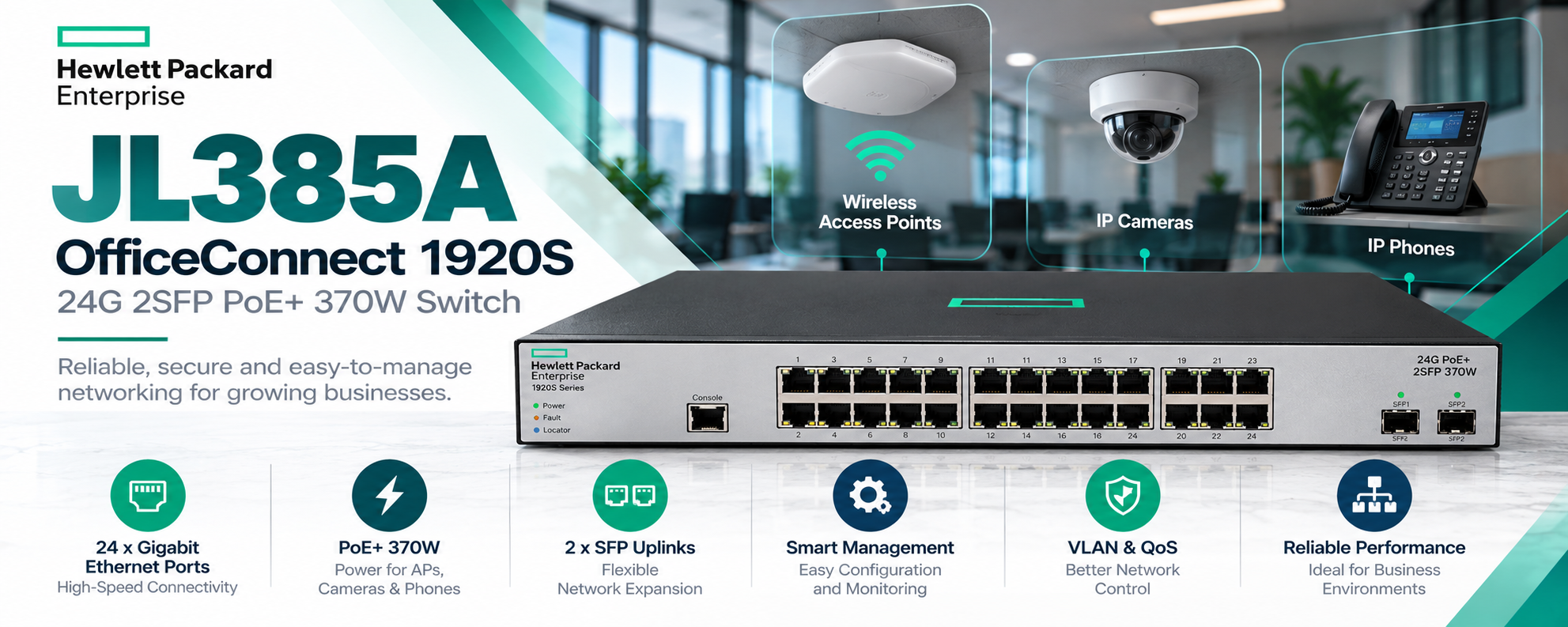
A reliable network switch is essential for businesses that depend on fast connections, IP phones, wireless access points, and security cameras. The HPE OfficeConnect JL385A 1920S 24G 2SFP PoE+ 370W Switch is designed to provide Gigabit Ethernet connectivity, centralized power delivery, and smart network management.
With 24 Gigabit Ethernet ports, two SFP uplinks, and a 370W Power over Ethernet budget, this switch provides a practical networking solution for small and medium-sized businesses.
This guide explores the JL385A switch's features, technical specifications, network performance, management capabilities, and business applications.
What Is the HPE OfficeConnect JL385A Switch?
The HPE JL385A is a 24-port smart-managed Gigabit Ethernet switch belonging to the OfficeConnect 1920S Series.
It provides reliable wired connectivity for computers, printers, wireless access points, IP telephones, and other network devices. Its integrated PoE+ functionality allows compatible equipment to receive both electrical power and data through Ethernet cables.
Unlike an unmanaged switch, the JL385A offers network configuration and monitoring features that help administrators organize traffic, manage connected devices, and improve network performance.
The switch is designed for businesses that need professional networking capabilities without the complexity of advanced enterprise switching platforms.
Key Features of the HPE JL385A 1920S Switch
24 Gigabit Ethernet Ports
The JL385A includes 24 RJ-45 Gigabit Ethernet ports supporting 10/100/1000 Mbps connectivity.
These ports automatically negotiate supported connection speeds with compatible devices, allowing organizations to connect equipment with different Ethernet capabilities.
Gigabit connectivity is particularly useful for businesses that regularly transfer documents, access shared storage, use cloud-based applications, or operate multiple network devices.
With 24 available ports, the switch can support a range of office equipment while providing room for additional wired connections.
370W Power over Ethernet Budget
One of the most important features of the JL385A is its 370W PoE+ power budget.
Power over Ethernet allows compatible devices to receive electrical power through the same Ethernet cable used for network connectivity.
This eliminates the need for separate power adapters near many connected devices and can simplify installation.
The switch supports PoE+ across its 24 Gigabit Ethernet ports, making it suitable for powering IP cameras, wireless access points, and VoIP phones.
However, the total power available to connected devices is limited to 370W. Administrators should calculate the power requirements of all connected PoE devices before deployment.
Two SFP Uplink Ports
The JL385A includes two SFP ports supporting 100 Mbps and 1 Gbps connections with suitable transceivers.
These ports allow the switch to connect to compatible fiber-optic networks or other networking equipment.
SFP connectivity is particularly useful when connecting equipment across longer distances than standard copper Ethernet cabling allows.
Fiber connections can also help businesses establish reliable links between network cabinets, floors, or separate buildings.
The JL385A does not provide native 10Gbps SFP+ uplinks, so organizations requiring 10Gbps fiber connections should consider a different switch model.
Smart Network Management
The JL385A includes smart-managed features that provide more administrative control than an unmanaged network switch.
Administrators can use its supported web-based management interface to configure network settings, monitor connected devices, and manage available switching features.
These capabilities help businesses maintain organized network operations without requiring a complex enterprise management environment.
HPE JL385A Technical Specifications
Switching Capacity and Throughput
The HPE JL385A delivers 52 Gbps switching capacity and supports a forwarding rate of up to approximately 77.3 million packets per second.
Switching capacity describes the aggregate traffic-handling capability of the switching architecture, while forwarding performance indicates how many packets the switch can process under specified conditions.
These capabilities are suitable for many small and medium-sized office environments where multiple Gigabit connections operate simultaneously.
Actual network performance depends on traffic patterns, device capabilities, and configuration.
Memory and Processing Hardware
The JL385A uses an ARM Cortex-A9 processor operating at 400 MHz.
It includes 256 MB of SDRAM and 64 MB of flash memory, supporting the switch's operating software and management functions.
The system also includes packet buffering to help manage network traffic during temporary periods of congestion.
These hardware resources are designed around the requirements of a smart-managed business switch.
Rack-Mount Design
The JL385A uses a 1U rack-mount form factor, allowing installation in a compatible standard 19-inch network rack.
This design helps organizations organize networking equipment within offices, server rooms, and communications cabinets.
Rack-mounted installation can improve equipment accessibility and simplify cable management.
Because the switch includes cooling fans, businesses should provide adequate ventilation and consider operating noise when selecting an installation location.
Network Management and Security Features
VLAN Support for Network Segmentation
Virtual Local Area Networks, commonly called VLANs, allow administrators to separate network traffic into different logical groups.
For example, a business may create separate VLANs for employees, guests, security cameras, and voice communication devices.
VLAN segmentation helps organize network traffic and can support security policies by separating different types of network activity.
However, VLANs alone do not provide complete network security. Appropriate access controls and routing policies are also necessary.
Quality of Service for Important Applications
Quality of Service, or QoS, helps administrators prioritize certain categories of network traffic.
This can be useful in offices where voice calls, video meetings, and standard data transfers share the same network infrastructure.
For example, prioritizing voice traffic can help reduce the effects of congestion on compatible VoIP applications.
QoS does not increase available bandwidth, but it can help ensure important applications receive suitable treatment when network traffic becomes busy.
Static Routing Capabilities
The JL385A supports limited Layer 3 static routing functionality.
Static routing allows administrators to configure predefined paths for traffic between supported networks.
This capability can be useful for relatively straightforward network designs that require some routing functionality without dedicated advanced routing equipment.
However, businesses requiring extensive dynamic routing, large routing tables, or advanced Layer 3 features should consider a more capable enterprise switch.
Network Loop Prevention
The JL385A supports Spanning Tree Protocol technologies, including STP, RSTP, and MSTP.
These technologies help prevent switching loops that could otherwise create excessive traffic and disrupt network operation.
Loop prevention becomes important when networks include multiple interconnected switches or redundant physical connections.
Proper configuration helps maintain network stability and supports more dependable connectivity.
Common Business Applications of the HPE JL385A
Small and Medium-Sized Offices
The JL385A is suitable for offices requiring multiple wired connections and centralized PoE power delivery.
Businesses can connect desktop computers, printers, IP phones, and wireless access points through a single smart-managed switch.
This can simplify network organization while providing administrators with visibility into connected equipment.
IP Surveillance Systems
Commercial surveillance systems often include multiple IP cameras that require continuous network connectivity and electrical power.
With its 24 PoE+ ports and 370W power budget, the JL385A can support compatible network cameras without separate power adapters.
Administrators must verify the power demand of each camera, particularly models with high-power features such as heaters or motorized movement.
Wireless Access Point Deployments
Businesses expanding wireless coverage may need several access points across offices, meeting rooms, and shared areas.
The JL385A can provide wired network connections and PoE+ power to compatible wireless access points.
This makes it useful for supporting centrally distributed wireless infrastructure.
Retail and Hospitality Networks
Retail stores, restaurants, and hospitality businesses often rely on connected devices such as payment terminals, phones, cameras, and wireless access points.
The JL385A can support these devices while allowing administrators to separate traffic through VLANs and manage network priorities.
Its suitability depends on the number of connected devices and the organization's security requirements.
HPE JL385A vs. JL384A: Which Is Better?
The HPE JL385A and JL384A are both members of the OfficeConnect 1920S Series.
Both provide 24 Gigabit Ethernet ports and two SFP uplinks, but their PoE configurations differ significantly.
The JL385A provides PoE+ on all 24 Ethernet ports with a 370W total power budget.
In comparison, the JL384A provides PoE+ on 12 of its 24 Ethernet ports, with a total power budget of 185W.
Businesses connecting numerous IP cameras, access points, or phones may benefit from the greater power capacity of the JL385A.
However, organizations with fewer PoE devices may find the JL384A sufficient for their requirements.
Is the HPE JL385A Worth Buying?
The HPE JL385A can be a practical choice for businesses maintaining or expanding an existing Gigabit Ethernet network.
Its 24 PoE+ ports, 370W power budget, two SFP uplinks, and smart management features offer a useful combination of connectivity and control.
However, businesses should consider their future networking requirements before purchasing.
Organizations planning to deploy newer high-performance wireless access points or requiring multigigabit Ethernet and 10Gbps uplinks may need more advanced switching hardware.
The JL385A is particularly relevant where standard Gigabit connections, basic network management, and centralized PoE power meet the organization's needs.
Before purchasing, verify the equipment's condition, firmware availability, power requirements, and compatibility with existing infrastructure.
Frequently Asked Questions
What is the HPE JL385A switch?
The HPE JL385A is a smart-managed OfficeConnect 1920S network switch featuring 24 Gigabit Ethernet ports, two SFP uplinks, and a 370W PoE+ power budget.
How many PoE ports does the JL385A have?
The JL385A supports PoE+ on all 24 Gigabit Ethernet ports. Its total available PoE power budget is 370W, shared across connected devices.
Does the HPE JL385A support 10Gbps connections?
No. The JL385A provides 10/100/1000 Mbps Ethernet ports and two SFP uplinks supporting up to 1Gbps. It does not include native 10Gbps SFP+ ports.
What is the switching capacity of the JL385A?
The JL385A provides 52 Gbps switching capacity and supports packet forwarding rates of up to approximately 77.3 million packets per second.
Can the JL385A power IP cameras?
Yes. The JL385A can power compatible PoE and PoE+ IP cameras. The total power requirements of connected cameras must remain within the switch's 370W PoE budget.
Does the JL385A support VLANs?
Yes. The JL385A supports VLAN configuration, allowing administrators to organize and separate network traffic for different users, devices, or departments.
Is the HPE JL385A a Layer 3 switch?
The JL385A is primarily a smart-managed Layer 2 switch with limited Layer 3 static routing capabilities. It is not a replacement for an advanced enterprise Layer 3 switch.
What is the difference between JL385A and JL384A?
The JL385A provides 24 PoE+ ports and a 370W power budget, while the JL384A provides 12 PoE+ ports and a 185W power budget. Both offer 24 Gigabit Ethernet ports and two SFP uplinks.
Conclusion
The HPE OfficeConnect JL385A 1920S 24G 2SFP PoE+ 370W Switch provides reliable Gigabit Ethernet connectivity, flexible network management, and centralized power delivery for small and medium-sized businesses.
With 24 PoE+ ports, a 370W power budget, VLAN support, and SFP connectivity, it is well suited to office networks, IP surveillance installations, and wireless access point deployments.
Businesses looking for a practical smart-managed Gigabit switch should evaluate the JL385A against their existing infrastructure, device power requirements, and future network expansion plans.
Technical accuracy note: The blog uses the HPE OfficeConnect 1920S specifications. The official product documentation confirms 24 PoE+ ports, two 100/1000 Mbps SFP uplinks, and a 370W PoE budget. Some specifications on the product listing, including 10G uplinks, stacking, and 176 Gbps switching capacity, do not match the manufacturer's documentation.

 English
 Arabic
 French
 Spanish
 Portuguese
 Deutsch
 Turkish
 Dutch
 Italiano
 Russian
 Portuguese (Brazil)
 Greek