


What Is a Finger Bridge in Motorcycle Racing Gloves, and When Does It Matter?
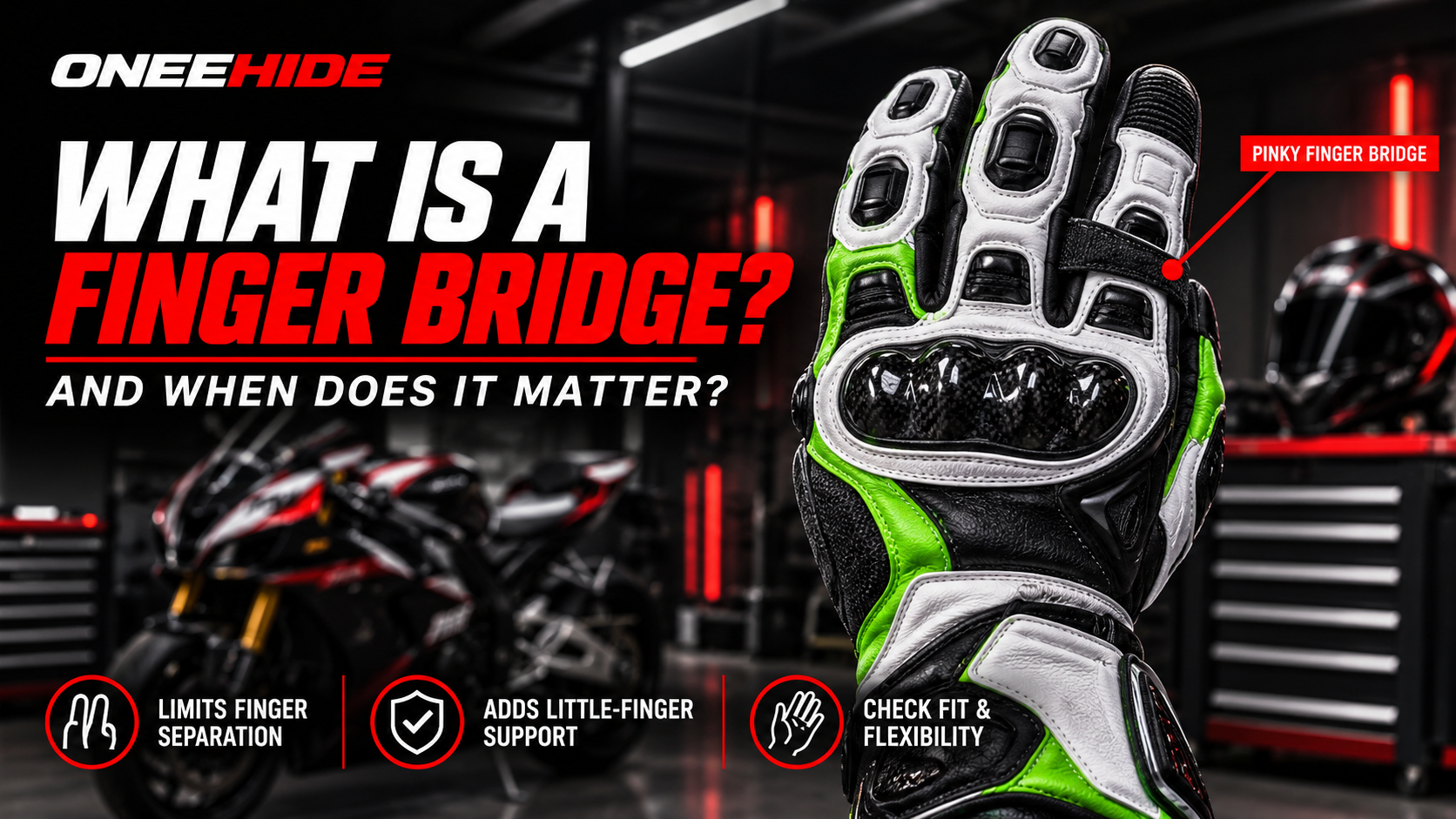
A motorcycle crash can expose parts of the hand to forces that ordinary riding movements rarely reproduce. While riders often pay attention to knuckle protectors, palm sliders, and wrist closures, one smaller feature deserves equal consideration: the finger bridge.
Also known as a pinky bridge or pinky tether, this feature connects the little finger to the adjacent ring finger through a reinforced section of glove material. Its purpose is to help limit the little finger's independent movement during an accident, particularly when the outside edge of the hand contacts the road.
Not every motorcycle glove includes this construction, and manufacturers do not all use the same design. Some use a leather or textile connection, while others incorporate dedicated anti-twist protection around the little finger.
Understanding how the feature works helps riders decide whether it is worth prioritising, how to evaluate its construction, and what to check before wearing the gloves on a track.
What Is a Finger Bridge in Motorcycle Racing Gloves?
A finger bridge is a reinforced connection between the ring finger and little finger of a motorcycle glove. It is designed to reduce the possibility of the little finger separating or being forced into an unnatural position during a crash.
The little finger sits along the outside edge of the hand, making it vulnerable when a rider falls and the hand contacts the asphalt. If the finger catches on the road surface or becomes trapped beneath part of the motorcycle, it can experience substantial twisting or bending forces.
A conventional glove provides coverage and material protection, but it does not necessarily restrict this type of movement.
A finger bridge addresses that particular concern by physically connecting two neighbouring fingers. Rather than allowing the little finger to move completely independently, the reinforced connection helps transfer some of the movement and loading towards the adjacent finger.
For riders comparing track motorcycle gloves, this is an additional protective feature worth examining alongside palm reinforcement, knuckle armour, finger protection, and wrist retention.
How Does a Pinky Bridge Work?
The construction is relatively simple, although the details vary between manufacturers.
A reinforced section of leather or another suitable material connects the ring finger and little finger. When the glove experiences movement around the outer edge of the hand, this connection is intended to limit excessive separation between the two fingers.
Consider what can happen during a sliding accident:
-
The rider loses control and makes contact with the track surface.
-
The outside edge of the hand touches or catches against the asphalt.
-
The little finger may experience a twisting or bending force.
-
The finger bridge helps restrict independent movement between the little finger and ring finger.
The feature does not eliminate the forces involved in a crash. It is designed to help reduce a particular type of finger movement that can contribute to injury.
Its effectiveness depends on the construction, material strength, stitching, positioning, and overall glove design.
Why Is the Little Finger Particularly Vulnerable in a Motorcycle Crash?
The little finger has an exposed position along the outside edge of the hand. During certain falls, that position can place it at risk of contacting the ground before other parts of the hand.
Dainese discusses this concern in its explanation of MotoGP glove construction. The manufacturer identifies the little finger as particularly exposed to serious trauma because it can contact the ground during a slide or become caught beneath the handlebars.
This is one reason racing glove manufacturers devote specific attention to little-finger protection.
The Risk of Finger Catching During a Slide
When a rider falls, the hand may come into contact with the track surface at an awkward angle.
If the little finger catches against the road while the rest of the hand continues moving, the finger can experience a force in a different direction from the other fingers.
This can place stress on the joints, ligaments, and surrounding soft tissue.
A finger bridge is intended to help limit this separation by connecting the little finger to the ring finger.
It does not guarantee that a finger will avoid injury. The hand can still experience impact, abrasion, compression, or rotational forces during a serious accident.
How Handlebar Contact Can Create Additional Risk
The vulnerability is not limited to contact with the road.
A rider's hand may also become trapped against motorcycle components during a fall. The handlebars, control assemblies, and other parts of the motorcycle can create situations where the little finger experiences an unusual bending or twisting movement.
Dainese addresses this concern through its proprietary Dainese Consolidated Protection (DCP) system.
The DCP design uses a protective insert near the base of the little finger, attached with aramid-fibre stitching. The manufacturer describes the system as helping limit unwanted movement and dangerous twisting.
This is a useful distinction: a conventional finger bridge connects neighbouring fingers, while a dedicated anti-twist insert uses a different construction approach to support the little finger.
Both approaches address the vulnerability of the outer edge of the hand, but they should not be treated as identical technologies.
Finger Bridge vs. Other Little-Finger Protection Systems
Not every racing glove protects the little finger in the same way. Some models use a physical connection between the ring finger and little finger, while others incorporate external guards, reinforced seams, or additional protective inserts.
Understanding these differences helps riders avoid assuming that every glove with prominent finger armour offers the same protection.
1. Traditional Leather Finger Bridge
A traditional finger bridge uses a reinforced section of leather or another material to connect the ring finger and little finger.
BMW Motorrad provides a clear manufacturer example in its M Pro Race Comp gloves. Its official product description identifies a leather bridge connecting the two fingers for injury protection.
The advantage of this design is that it integrates the connection into the glove's existing construction.
However, the strength and effectiveness of the connection depend on its material, stitching, and attachment points. A decorative strip between the fingers should not automatically be considered a protective finger bridge.
2. Dedicated Anti-Twist Protection
Some manufacturers use a separate protective component instead of relying entirely on a connecting strip.
Dainese's DCP system is one example. The protective insert is positioned near the base of the little finger and is intended to restrict unwanted movement.
This approach provides targeted protection without necessarily using the same visible bridge construction found on other racing gloves.
The main consideration is whether the design supports the little finger without interfering with normal hand movement.
3. External Pinky Reinforcement
Another approach involves adding protective material or a moulded guard to the outside edge of the little finger.
This reinforcement can provide an additional barrier against abrasion and external contact.
However, external protection and a finger bridge serve different functions. A reinforced outer guard does not automatically prevent the little finger from moving independently during an accident.
For this reason, riders should assess the complete protective construction instead of judging a glove by one prominent feature.
When Does a Finger Bridge Matter Most?
A finger bridge is particularly relevant for riders who use racing-oriented gloves during track riding or other demanding motorcycle activities.
The potential exposure of the little finger during a fall is not exclusive to professional racing. However, the level of protection required can vary according to the riding environment, glove design, and expected use.
Track Days and Sport Riding
Track riding involves repeated braking, acceleration, cornering, and changes in body position.
Racing gloves designed for this environment generally incorporate multiple protective features, including reinforced palms, knuckle protectors, and wrist restraints.
A finger bridge adds a specific layer of protection for the little finger.
Riders who regularly attend track days may find this feature particularly relevant when comparing two gloves with otherwise similar protective specifications.
High-Performance Road Riding
A finger bridge can also be useful on public roads.
Motorcycle accidents are not limited to high-speed crashes. A relatively low-speed fall can still result in an awkward hand position or contact with the road.
A glove with a reinforced finger connection may offer an additional design consideration for riders seeking protection beyond basic hand coverage.
However, the presence of a finger bridge should never be used as the sole reason to choose a motorcycle glove.
Everyday Motorcycle Use
Commuters and occasional riders may also benefit from additional little-finger protection, although their preferred glove design may prioritise flexibility, comfort, weather resistance, or ease of use.
A highly reinforced racing glove may feel excessive for short everyday journeys, particularly if the construction restricts movement or does not suit the rider's normal hand position.
The objective is to select a glove that provides appropriate protection without creating unnecessary ergonomic difficulties.
Does a Finger Bridge Affect Comfort and Finger Movement?
A properly designed finger bridge should provide its intended protective connection without making ordinary hand movements uncomfortable.
However, riders may notice differences between gloves depending on the bridge's placement, material, and construction.
The ring finger and little finger need to move together to some extent, but they still require sufficient flexibility for gripping the handlebars and operating motorcycle controls.
Check the following areas when trying a new pair:
-
Finger separation: The connection should not create uncomfortable pulling between the two fingers.
-
Grip position: Both fingers should sit naturally when holding the handlebar grip.
-
Clutch and brake operation: The design should not interfere with the fingers used to operate the levers.
-
Knuckle movement: The connection should not create excessive tension when bending the fingers.
-
Internal seams: The bridge should not produce hard pressure points or irritating friction inside the glove.
A glove that fits correctly while the hand is open may feel different when the fingers are curled around a handlebar.
Therefore, test the gloves in a realistic riding position rather than judging their comfort by simply putting them on and closing the wrist strap.
Can a Finger Bridge Restrict Independent Finger Movement?
Yes, some restriction is inherent in the design because the bridge physically connects two fingers.
The objective is not to immobilise the hand. Instead, manufacturers aim to provide a balance between limiting unwanted movement and preserving the dexterity required for motorcycle control.
The quality of the design matters here. A connection that creates excessive tension can make the glove uncomfortable and interfere with the rider's ability to use the controls naturally.
Never assume that a tighter bridge provides better protection. Fit, material flexibility, stitching integrity, and the glove's overall construction must be considered together.
What Does EN 13594 Certification Tell You About Finger Bridges?
EN 13594:2015 is a European standard covering protective gloves for motorcycle riders. It addresses requirements such as sizing, ergonomics, mechanical properties, impact protection, marking, and user information.
The standard identifies two performance levels:
-
Level 1: Protection with relatively low ergonomic penalties.
-
Level 2: Increased protective performance compared with Level 1, potentially involving additional weight or movement restrictions.
The standard does not establish a universal requirement for every motorcycle glove to include a finger bridge.
This distinction is important because a glove without a visible pinky bridge is not automatically non-compliant. Certification evaluates the applicable requirements of the complete glove rather than requiring every manufacturer to use identical protective technology.
The EN 13594:2015 standard also describes the need to preserve the rider's dexterity when operating motorcycle controls.
In other words, protective construction must be considered alongside practical hand movement.
When examining a glove's certification, check the actual marking and manufacturer documentation. Do not assume that a finger bridge alone establishes a particular protection level.
How to Inspect a Finger Bridge Before Buying or Riding
A finger bridge should be checked as carefully as the glove's palm, knuckle, and wrist protection.
Look closely at the connecting material and examine how it joins the two finger sections. The connection should appear integrated into the glove's protective construction rather than attached as a loose decorative feature.
Use this practical inspection process:
1. Examine the material. Check whether the bridge uses reinforced leather or another material specified by the manufacturer.
2. Inspect the stitching. Look for irregular seams, loose threads, fraying, or separation around the attachment points.
3. Check finger alignment. The ring finger and little finger should sit naturally inside their respective compartments.
4. Test natural movement. Bend the fingers and make a relaxed fist. The bridge should not produce uncomfortable pulling or sharp pressure.
5. Test the riding grip. Hold a handlebar or a similarly shaped object and check whether the connection interferes with control operation.
6. Reinspect after use. Look for signs of deterioration, particularly if the gloves have been exposed to moisture, abrasion, or repeated stretching.
If the bridge becomes damaged or starts separating from the glove, do not attempt an improvised repair with household glue or ordinary stitching. Contact the manufacturer or a qualified protective-gear repair specialist to determine whether the glove can be repaired safely.
A damaged bridge should not be assumed to provide its original protective function.
Choosing Racing Gloves With the Right Finger Protection
A finger bridge is a valuable feature to consider, but it should form part of a broader evaluation of motorcycle glove construction.
Before purchasing racing gloves, examine how the following features work together:
|
Protective feature |
Main purpose |
|
Finger bridge |
Helps limit independent movement between the little and ring fingers |
|
Knuckle protection |
Provides protection over the knuckles during impact |
|
Palm reinforcement |
Adds protective material to an exposed contact area |
|
Palm slider |
Helps the hand slide rather than catch during certain contacts |
|
Finger armour |
Provides additional coverage to exposed finger areas |
|
Wrist restraint |
Helps keep the glove securely attached |
|
Reinforced seams |
Support the integrity of the glove's construction |
A rider should also consider glove length, material, sizing, and compatibility with the jacket sleeves.
There is no single protective feature that makes a glove suitable for every rider or every motorcycle discipline. The best assessment comes from examining the complete construction, checking recognised certification where applicable, and making sure the gloves fit properly.
For track use, test the gloves in the position you actually ride in. Your fingers should reach the controls naturally, the wrist closure should remain secure, and the little-finger protection should not interfere with ordinary movement.
A finger bridge may look like a small detail, but its purpose addresses a specific weakness in hand protection. Understanding that function makes it easier to compare racing gloves based on how they are constructed, rather than relying on appearance or marketing descriptions alone.
Add a direct buyer’s takeawayReduce repeated protection explanations

 English
 Arabic
 French
 Spanish
 Portuguese
 Deutsch
 Turkish
 Italiano
 Russian
 Romaian
 Portuguese (Brazil)
 Greek