


How Real-Time Video Analytics Helps Airports Identify Operational Bottlenecks
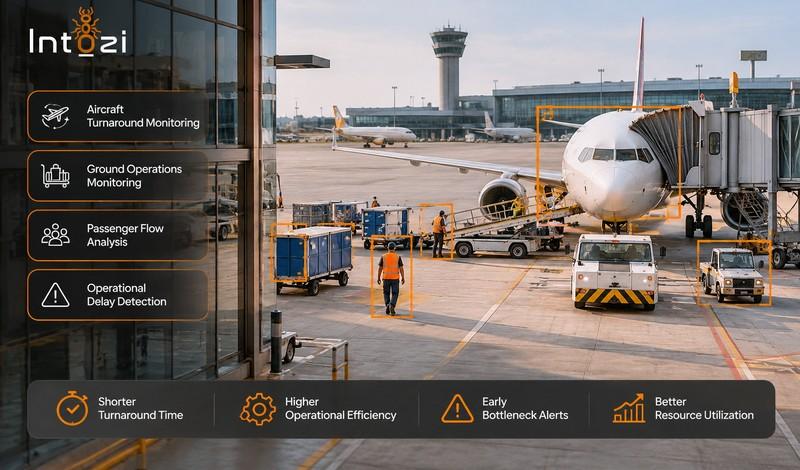
Airports handle thousands of passengers, vehicles, baggage movements, and aircraft operations every day. Even a small delay in one activity can affect multiple connected processes, leading to congestion, missed schedules, and inefficient resource utilisation. Airport Operational Intelligence helps address these challenges by converting visual information from airport surveillance systems into insights that support faster operational decisions.
Traditional CCTV systems provide continuous video coverage, but manually monitoring multiple camera feeds makes it difficult to identify developing delays. Real-time video analytics uses artificial intelligence (AI) and computer vision to detect activities, track movement, and highlight operational exceptions.
Why Airport Operational Bottlenecks Affect Overall Efficiency
Airport operations depend on coordination between ground handling teams, security personnel, airline staff, and airport management. A delay in baggage handling, aircraft servicing, or passenger processing can affect other activities and disrupt schedules. Identifying these bottlenecks early helps airport teams understand where delays occur and respond before they create wider operational challenges.
Common operational bottlenecks include:
-
Delays in aircraft servicing and turnaround activities.
-
Congestion around baggage handling and loading areas.
-
Uncoordinated ground vehicle movement across airport aprons.
-
Long passenger queues at security checkpoints and boarding gates.
-
Inefficient utilisation of ground support equipment and personnel.
How Real-Time Video Analytics Improves Airport Ground Operations Monitoring
Real-time video analytics processes live footage from compatible IP cameras using AI models. It identifies vehicles, people, objects, and activities within defined camera views. These detections help airport teams understand movement patterns and identify situations that may require attention.
For example, AI-based monitoring can support:
-
Vehicle tracking: Monitor ground vehicle movement across designated operational zones.
-
People counting: Estimate passenger numbers and identify increasing crowd density.
-
Queue monitoring: Detect queue build-ups at selected terminal locations.
-
Activity detection: Identify specific activities and unusual events in monitored areas.
-
Dwell-time monitoring: Highlight vehicles or objects remaining in defined zones beyond configured thresholds.
These capabilities provide additional visibility into airport operations without requiring personnel to continuously observe every camera feed.
Key Applications of Airport CCTV Analytics for Operational Bottleneck Detection
Airport CCTV Analytics can support several operational monitoring requirements when cameras provide suitable coverage and analytics are configured for specific activities. By analysing video streams, AI systems can help identify delays, unusual movement, and congestion across different airport environments.
Important applications include:
-
Aircraft turnaround monitoring: Observe ground activities around aircraft stands and identify potential delays in servicing processes.
-
Baggage movement monitoring: Detect unusual accumulation or interruptions in baggage movement.
-
Apron vehicle monitoring: Track vehicle movement and identify congestion in designated areas.
-
Passenger flow analysis: Monitor crowd density and queue conditions across terminals.
-
Restricted-area monitoring: Detect unauthorised entry into operational or safety-sensitive zones.
The Role of AI Surveillance Software in Airport Safety Monitoring
Airport Safety Monitoring involves identifying conditions that could create risks for passengers, employees, aircraft, and ground operations. AI surveillance software adds automated detection capabilities to conventional CCTV infrastructure, helping teams identify selected safety and security events more efficiently.
Depending on camera positioning and configured analytics, AI systems can detect restricted-area intrusion, monitor vehicle movement, identify unattended objects, and highlight unusual activities. Alerts can be generated when predefined conditions are met, allowing authorised personnel to investigate events and take appropriate action.
Video analytics supports operational awareness, but it does not replace established airport safety procedures, trained personnel, or regulatory compliance requirements.
Optimizing Airport Operations with AI Through Operational Intelligence
Optimizing airport operations with AI requires more than detecting individual events. Airport teams need to understand where operational delays occur, how activities are connected, and which areas require attention. Video analytics can provide structured information from camera footage to support this process.
When integrated with relevant airport management systems, video analytics data can complement flight schedules, ground handling records, and resource information. This broader operational view can help teams investigate recurring bottlenecks, improve coordination, and make informed decisions about resource allocation.
How Intozi and Ikshana Support Intelligent Airport Monitoring
Intozi develops computer vision and video analytics solutions for monitoring complex operational environments. Its Ikshana Vision AI Platform analyses compatible CCTV streams to support applications such as vehicle detection, people counting, crowd analytics, intrusion detection, and activity monitoring..
Frequently Asked Questions (FAQs)
How does real-time video analytics help airports reduce operational delays?
Real-time video analytics helps airports identify activities that may contribute to operational delays. It can monitor passenger queues, ground vehicle movement, baggage handling areas, and aircraft servicing zones. AI-based detection can highlight congestion, unusual activity, or prolonged presence in defined areas. Airport teams can use these alerts to investigate potential bottlenecks and coordinate responses. The effectiveness depends on camera coverage, analytics configuration, and integration with relevant operational systems.
What is the role of AI in airport ground operations monitoring?
AI supports airport ground operations monitoring by analysing video feeds to detect vehicles, people, objects, and activities. It can help monitor apron vehicle movement, aircraft servicing zones, baggage handling areas, and restricted operational locations. These insights provide ground operations teams with better visibility into activities across multiple areas. AI does not independently manage airport operations, but it can support staff with timely alerts and information for operational decision-making.
Can existing airport CCTV cameras be used for AI video analytics?
Yes, compatible existing IP CCTV cameras can often be integrated with AI video analytics platforms. The suitability depends on camera resolution, viewing angle, lighting, network connectivity, and the specific analytics requirement. Airports may not need to replace their entire surveillance infrastructure to introduce AI monitoring. Platforms such as Intozi's Ikshana can analyse compatible video streams through suitable edge or server-based deployments, subject to technical assessment.
How does AI support aircraft turnaround monitoring?
AI can support aircraft turnaround monitoring by analysing video footage around aircraft stands and designated ground handling zones. It can detect service vehicles, personnel, and activities associated with aircraft preparation. Configured analytics can highlight prolonged inactivity, unusual movement, or potential delays in monitored areas. These insights help airport teams investigate operational exceptions. Accurate turnaround assessment may also require integration with flight schedules and ground handling management systems.
Which airport activities can Ikshana monitor through video analytics?
Intozi's Ikshana Vision AI Platform supports configurable video analytics for activities such as vehicle detection and tracking, people counting, crowd monitoring, intrusion detection, and activity monitoring. In airport environments, these capabilities can support apron monitoring, passenger flow visibility, restricted-area surveillance, and selected ground operations. The specific applications depend on camera coverage, deployment architecture, and the analytics configured for the airport's operational requirements.

 English
 Arabic
 French
 Spanish
 Portuguese
 Deutsch
 Dutch
 Italiano
 Russian
 Romaian
 Portuguese (Brazil)
 Greek