


Revision With a Class 10 Formula Sheet and Class 12 Question Bank
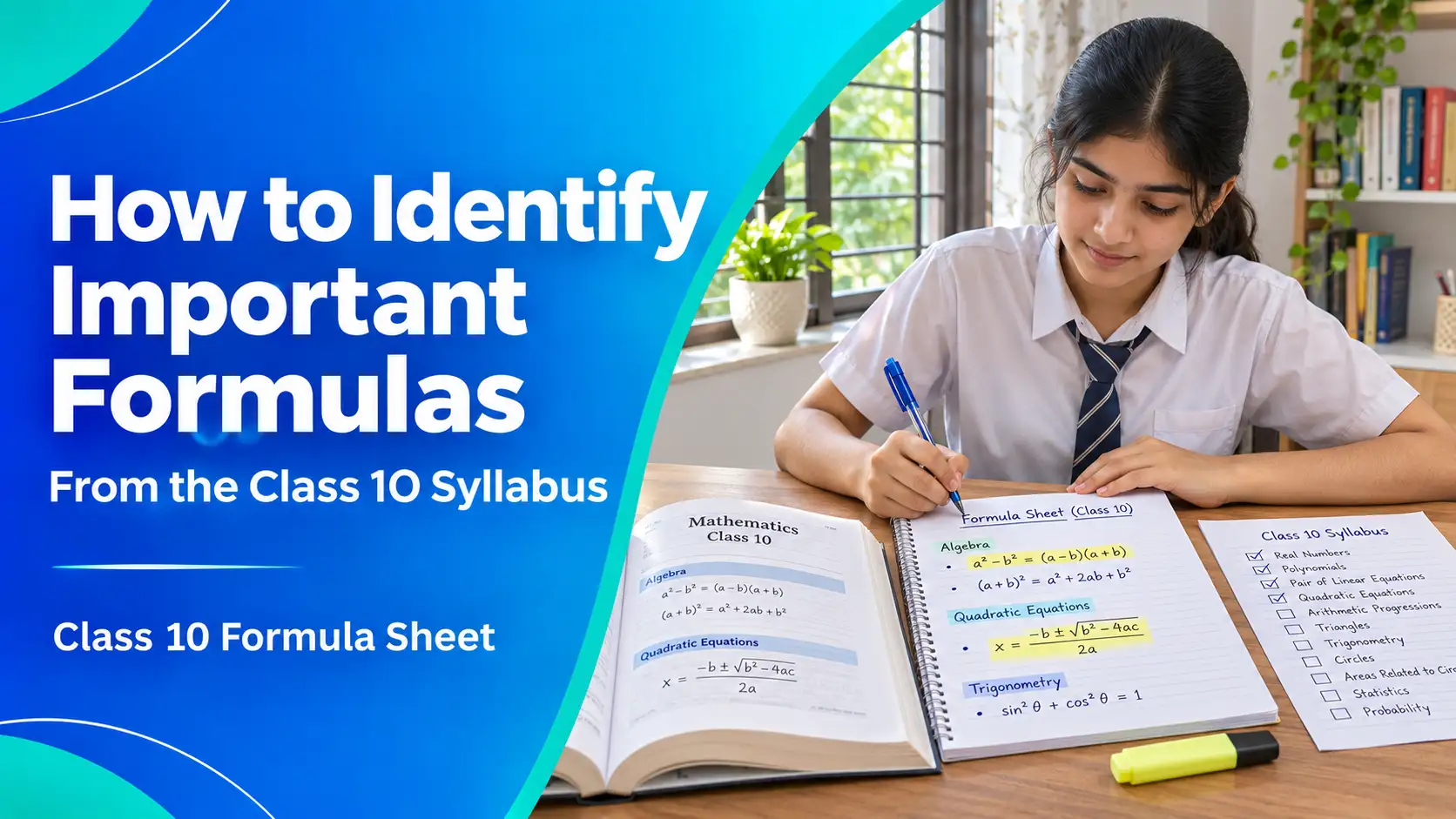
Exam preparation becomes more effective when students know how to use each study resource for a specific purpose. Reading chapters builds understanding, revision strengthens memory, and question practice shows whether concepts can actually be applied.
For Class 10 students, a Class 10 Formula Sheet can make formula revision quicker and more organised. For Class 12 students, a CBSE Class 12 Question Bank can provide additional practice and help identify areas that need more attention.
Why Revision Should Be Planned
Unplanned revision often leads students to spend too much time on chapters they already know while ignoring difficult areas.
A better approach is to divide preparation into four stages:
Learn → Revise → Practise → Analyse
First understand the topic. Then revise important information, solve questions, and analyse mistakes. This cycle can be repeated until the topic becomes more familiar.
How to Use a Class 10 Formula Sheet
Formula-based subjects require regular recall. Students may understand a formula when they first learn it but struggle to remember it later.
A formula sheet can act as a quick revision tool.
Review Formulas Before Solving Questions
Before starting a practice session, spend a few minutes reviewing the formulas related to the chapter.
Do not simply read them. Try to recall what each symbol means and when the formula should be applied.
Test Yourself Without Looking
Close the formula sheet and write down the formulas you remember.
Then compare your list with the original.
This method quickly shows which formulas require additional revision.
Apply Formulas Immediately
After revision, solve a few questions using those formulas.
Application is important because remembering an equation does not guarantee that you will know when to use it.
Avoid Memorising Formulas Without Understanding
Formula memorisation alone can cause confusion when questions are presented differently from examples studied in class.
For each formula, understand:
-
What each variable represents
-
When the formula is applicable
-
How the formula relates to the underlying concept
-
Whether it can be rearranged
-
Which similar formulas students commonly confuse
Once the meaning is clear, recall becomes easier.
Using a Class 12 Question Bank Effectively
A CBSE Class 12 Question Bank can support preparation by providing additional questions for practice.
However, students should avoid solving questions randomly without analysing the results.
After completing a chapter, organise practice into stages:
Basic Questions → Application Questions → Mixed Questions → Timed Practice
Start with questions that confirm your understanding. Then move toward questions that require greater application.
Analyse Every Wrong Answer
A wrong answer is useful only if you understand why it happened.
Ask yourself:
Was the Concept Unclear?
Return to the relevant chapter section and revise the underlying idea.
Did You Forget a Formula?
Add the formula to your quick-revision list and practise using it again.
Was It a Calculation Error?
Repeat similar questions while paying attention to each calculation step.
Did You Misread the Question?
Underline or mentally identify the important information before beginning the solution.
This process turns mistakes into specific revision tasks.
Maintain a Personal Error Log
Students can maintain a simple table to record recurring problems.
| Topic | Mistake | Reason | Next Step |
|---|---|---|---|
| Mathematics | Wrong formula | Poor recall | Revise formula |
| Physics | Incorrect method | Concept gap | Review concept |
| Chemistry | Wrong reaction | Weak recall | Practise again |
| English | Incorrect option | Grammar confusion | Revise rule |
Review the log regularly.
If the same mistake appears multiple times, prioritise it instead of simply moving on to another chapter.
Combine Active Recall With Practice
Rereading notes can make information feel familiar, but familiarity does not always mean that you can recall it independently.
Use active recall during revision.
Close your notes and try to write:
-
Important formulas
-
Definitions
-
Key concepts
-
Processes
-
Important points from a chapter
Then check your response and correct anything you missed.
Follow this with question practice to test whether you can apply the information.
Use Timed Practice After Building Accuracy
Speed should not be the first goal.
Initially, focus on solving questions correctly. Once your approach becomes reliable, introduce time limits.
A practical progression is:
Concept Understanding → Accurate Practice → Timed Sets → Mixed Practice
If your accuracy drops significantly when the clock is introduced, work on your solving method before trying to increase speed further.
Prioritise Weak Areas
Not every chapter requires the same amount of revision time.
Divide your topics into three categories.
Strong Areas
You understand these topics and make few mistakes. Revise them periodically.
Moderate Areas
You understand the basics but need more practice to become consistent.
Weak Areas
You struggle with concepts or frequently make mistakes. Return to the fundamentals before attempting advanced questions.
This approach prevents comfortable topics from taking up most of your study time.
Follow a Weekly Revision Routine
A simple schedule can keep preparation balanced.
Monday: Revise concepts and formulas.
Tuesday: Solve chapter-wise questions.
Wednesday: Work on weak topics.
Thursday: Complete timed practice.
Friday: Review the error log.
Saturday: Attempt mixed questions.
Sunday: Revise the week's difficult areas.
You can modify this schedule according to your subjects and examination timeline.
Avoid Collecting Too Many Resources
Using too many books and online resources can make preparation scattered.
The objective is not to solve every question available. Instead, choose useful resources and work through them carefully.
A question that you analyse properly can be more valuable than several questions that you solve without reviewing your mistakes.
Final Revision Before the Examination
As the examination gets closer, shift your attention toward revision and application.
For Class 10, regularly revisit important formulas and practise questions based on them.
For Class 12, use question practice to identify weak chapters, review difficult concepts, and improve your ability to solve different question types.
Focus your final revision on:
-
Important formulas
-
Difficult topics
-
Repeated mistakes
-
Key concepts
-
Timed question practice
-
Previously challenging questions
Avoid making your preparation unnecessarily complicated during the final stage.
Conclusion
A Class 10 Formula Sheet can make formula revision more efficient, while a CBSE Class 12 Question Bank can provide structured opportunities for question practice. However, neither resource should be used passively.
The most effective routine is simple: understand the concept, revise important information, solve questions, analyse mistakes, and revisit weak areas.
Consistent use of this cycle can make revision more organised and help students approach their examinations with a clearer understanding of what they know and what still needs work.

 English
 Arabic
 French
 Spanish
 Portuguese
 Deutsch
 Dutch
 Italiano
 Russian
 Romaian
 Portuguese (Brazil)
 Greek