In modern manufacturing, electric resistance welding (ERW) stands as one of the most efficient and widely adopted metal joining technologies. From automotive body structures to HVAC systems, battery enclosures, and precision sheet metal assemblies, ERW enables manufacturers to achieve high-speed, repeatable, and automation-ready welding performance with minimal consumables.
For OEMs, fabrication plants, and automation integrators, understanding this process is essential for optimizing production quality, reducing cycle time, and improving weld consistency. At Heron Welder, ERW technology forms the backbone of advanced resistance welding systems used across global industries.
What is Electric Resistance Welding?
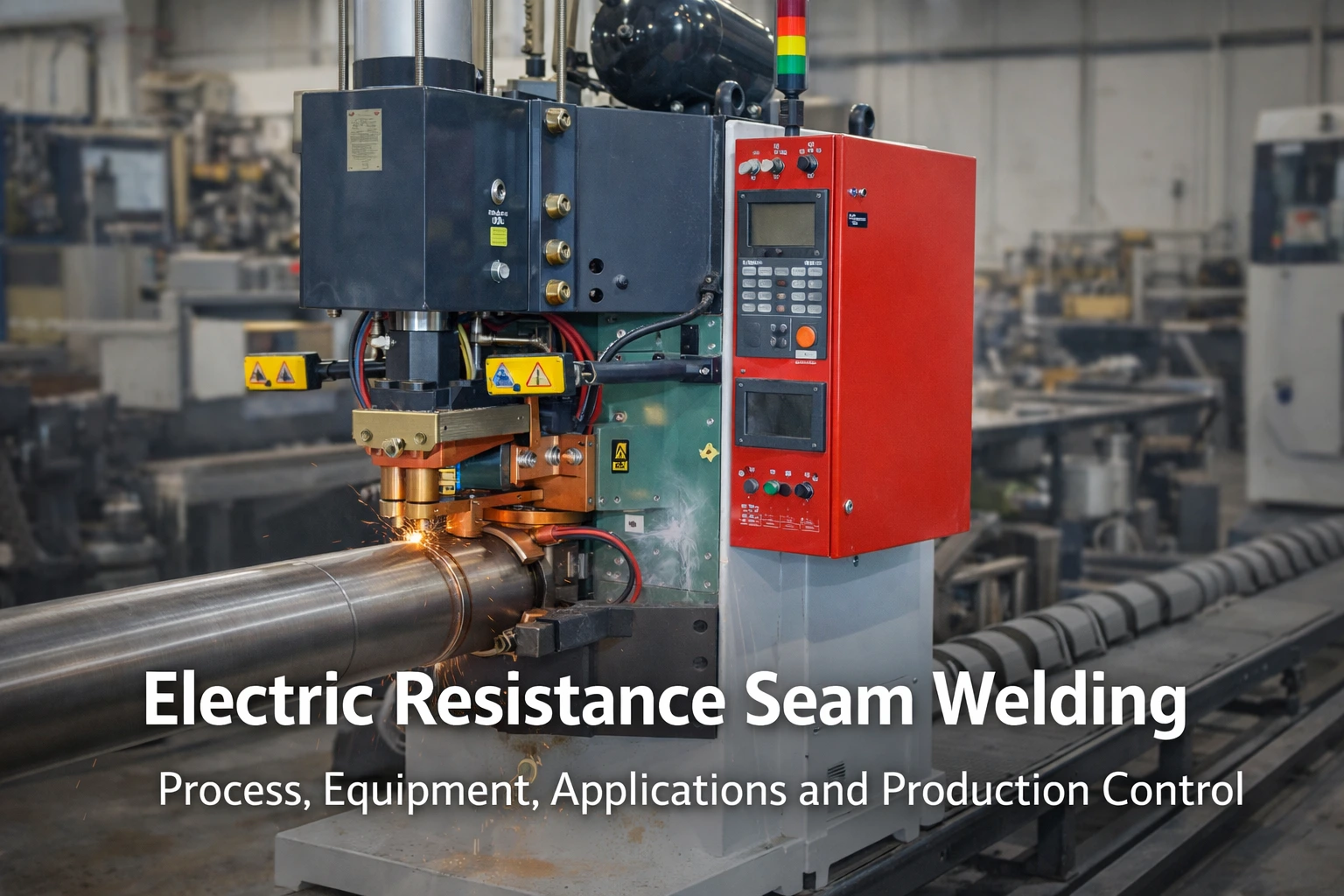
Electric resistance welding is a solid-state welding process that joins metal parts using heat generated by electrical resistance combined with mechanical pressure. No filler material, flux, or external heating source is required.
The fundamental principle is simple:
When high current passes through metal contact surfaces, resistance at the interface generates intense heat, causing localized melting or softening. Under pressure, the materials fuse together.
The heat generation follows the basic Joule’s law concept:
Q=I2RtQ = I^2 R tQ=I2Rt
Where:
- Q = heat energy
- I = current
- R = resistance
- t = time
This controlled energy input is what makes ERW highly suitable for precision manufacturing environments where consistency and repeatability are critical.
Core Working Principle of ERW
Electric resistance welding operates using three key parameters:
- Welding current
- Electrode force (pressure)
- Welding time
When two metal sheets are clamped between copper electrodes, a high current is passed through the joint area. Because metals like steel offer resistance to current flow, heat is generated at the interface.
Under applied pressure, the softened material forms a solid metallurgical bond.
This controlled interaction between heat and force allows ERW to produce strong, clean, and localized welds without distortion or excessive heat-affected zones.
Types of Electric Resistance Welding Processes
ERW is not a single technique it includes several industrial variations designed for different production needs.
1. Resistance Spot Welding (RSW)
The most widely used ERW method, especially in automotive manufacturing. It creates individual weld “nuggets” by applying current through electrodes.
- Used for sheet metal joining
- High-speed automation friendly
- Ideal for car bodies, appliances, enclosures
2. Seam Welding
Uses rotating wheel electrodes to produce continuous weld seams.
- Produces leak-proof joints
- Used for fuel tanks, pipes, containers
- Supports high-volume production
3. Projection Welding
Uses raised projections on one workpiece to concentrate current and heat.
- Multiple welds in one cycle
- Used for fasteners, nuts, brackets
4. Capacitor Discharge Welding (CDW)
A high-speed variant using stored electrical energy for ultra-fast welding.
- Extremely short weld time (milliseconds)
- Minimal thermal distortion
- Ideal for precision components
Industrial Applications of Electric Resistance Welding
Electric resistance welding is heavily integrated into modern production systems due to its speed and automation compatibility.
Automotive Industry
- Body-in-white assembly
- Door panels and structural frames
- Battery trays for EVs
HVAC & Appliance Manufacturing
- Air conditioning units
- Water heaters and ducts
- Refrigerator panels
Electrical & Battery Industry
- Busbars and terminals
- Lithium-ion battery packs
- Electrical enclosures
Metal Fabrication & OEM Production
- Cabinets and enclosures
- Steel furniture
- Industrial sheet metal assemblies
Across all these sectors, ERW enables high-volume, low-cost, and consistent production with minimal operator intervention.
Advantages of Electric Resistance Welding
For engineering teams and factory decision-makers, ERW provides several strategic advantages:
1. High Production Speed
Weld cycles are extremely short, making it ideal for automated production lines.
2. No Consumables Required
No filler wire, flux, or shielding gas is needed, reducing operational cost.
3. Automation Ready
Easily integrated into robotic systems and PLC-controlled production cells.
4. Clean and Precise Welds
Produces minimal spatter, distortion, and post-processing requirements.
5. Energy Efficient
Heat is generated only at the weld interface, reducing energy waste.
Limitations and Engineering Considerations
Despite its benefits, ERW requires careful process control:
- Requires precise joint alignment
- Limited effectiveness on very thick materials
- Electrode wear must be managed
- Requires stable power control systems
Advanced systems like MFDC (Medium Frequency Direct Current) help overcome many of these challenges by providing better current control and energy efficiency.
ERW in Smart Manufacturing and Automation
Modern factories are rapidly shifting toward Industry 4.0 production systems. ERW integrates seamlessly into this environment through:
- Real-time weld monitoring
- Adaptive current control
- Data-driven quality inspection
- Robotic welding arms and gantry systems
These advancements allow manufacturers to reduce defect rates while improving throughput and traceability.
How Heron Welder Supports ERW Technology
As a global manufacturer of resistance welding systems, Heron Welder specializes in:
- Spot welding machines
- Seam welding systems
- Projection welding equipment
- MFDC resistance welding platforms
- Automated welding production lines
- Custom welding guns and controllers
Our solutions are engineered for high-precision industrial environments, supporting OEMs and Tier-1 suppliers in automotive, HVAC, and heavy manufacturing sectors.
By combining mechanical design expertise with advanced welding control systems, Heron delivers solutions that improve productivity, weld quality, and long-term operational reliability.
Frequently Asked Questions (FAQs)
1. What materials can be welded using electric resistance welding?
ERW is commonly used for low-carbon steel, stainless steel, aluminum (with advanced systems), and coated sheet metals.
2. Is electric resistance welding suitable for automation?
Yes, ERW is highly automation-friendly and widely used in robotic welding lines in automotive and appliance manufacturing.
3. What is the main difference between spot welding and seam welding?
Spot welding creates individual weld points, while seam welding produces continuous leak-proof joints using rotating electrodes.
4. Does ERW require filler material?
No, ERW does not use filler metals or flux; it relies solely on heat and pressure.
5. What industries benefit most from ERW?
Automotive, HVAC, battery manufacturing, appliance production, and metal fabrication industries benefit the most.
Conclusion
Electric resistance welding remains a cornerstone of modern industrial manufacturing due to its speed, efficiency, and compatibility with automation systems. As production demands increase, manufacturers are shifting toward advanced ERW solutions that offer greater precision and process control.
With decades of expertise in resistance welding technology, Heron Welder continues to support global manufacturers with robust, scalable, and automation-ready welding systems designed for today’s high-performance production environments.
Request a Custom Welding Solution
Looking to improve your production efficiency or integrate advanced electric resistance welding into your factory line?
Heron Welder provides customized welding machines, automation systems, and engineering support tailored to your application.
Contact our technical team today for a consultation or quotation on your next welding automation project.




 English
 Arabic
 French
 Spanish
 Portuguese
 Deutsch
 Turkish
 Dutch
Dutch
 Italiano
 Russian
 Portuguese (Brazil)
 Greek
Greek