


Nanosatellite and Microsatellite Market: Transforming the Economics of Space-Based Connectivity and Earth Observation The global nanosatellite and microsatellite market is experiencing rapid expansion as the space industry transitions toward smaller, lower
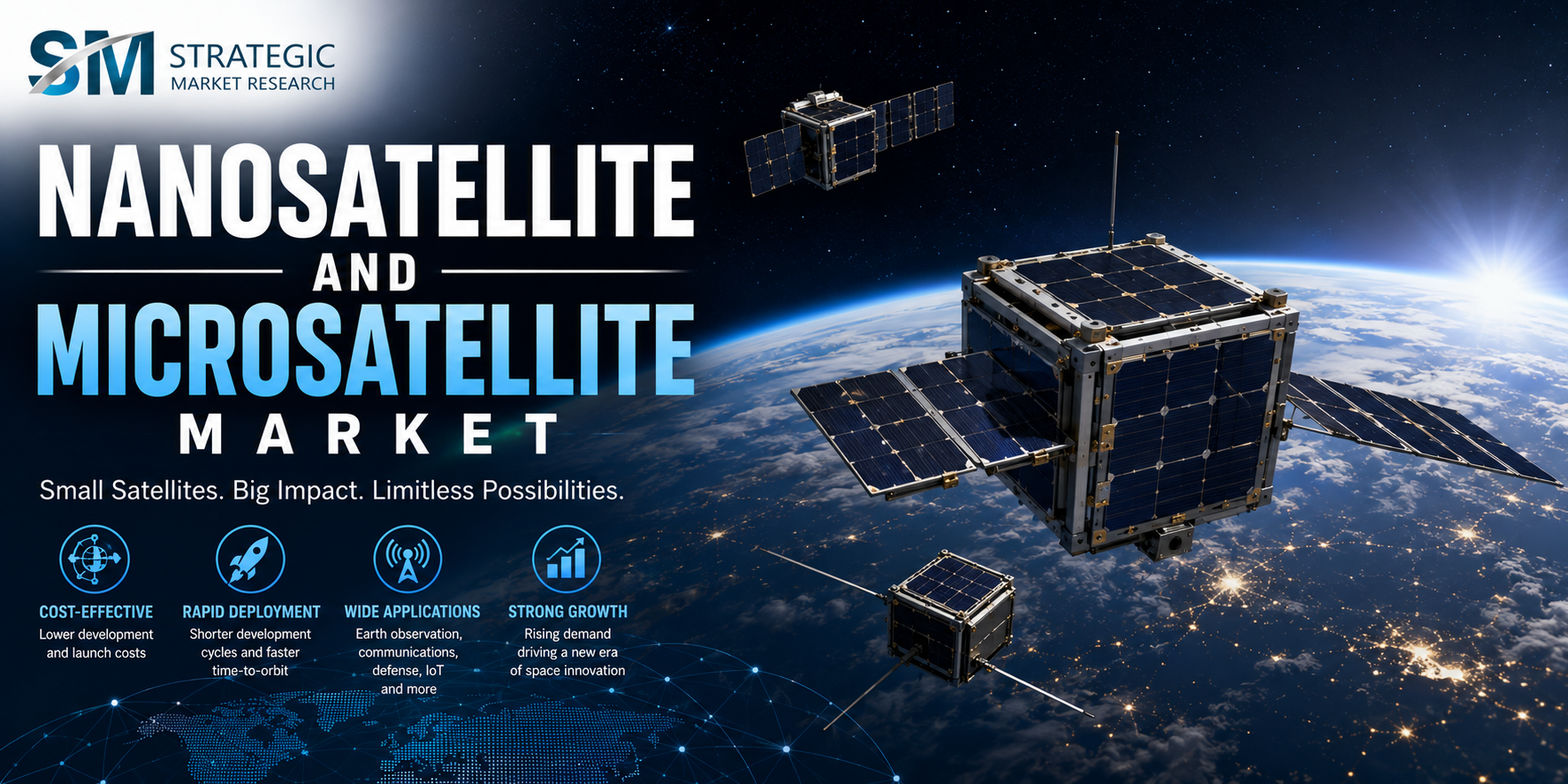
Nanosatellite and Microsatellite Market: Transforming the Economics of Space-Based Connectivity and Earth Observation
The global nanosatellite and microsatellite market is experiencing rapid expansion as the space industry transitions toward smaller, lower-cost, and highly agile satellite platforms capable of delivering advanced communication, Earth observation, navigation, scientific, and defense capabilities. The commercialization of space technologies, falling launch costs, rapid satellite miniaturization, and growing demand for real-time geospatial intelligence are fundamentally reshaping the global satellite ecosystem.
Nanosatellites and microsatellites are becoming central to next-generation space infrastructure because they offer faster deployment cycles, lower manufacturing costs, and the ability to operate in coordinated constellations. These satellites are increasingly used for remote sensing, broadband connectivity, maritime monitoring, environmental surveillance, precision agriculture, military intelligence, IoT connectivity, and disaster management applications.
Unlike traditional large satellites that often require years of development and high launch expenditures, nanosatellites and microsatellites provide a more flexible and commercially scalable alternative. Governments, defense agencies, research institutions, and private space companies are heavily investing in small satellite constellations to improve operational efficiency, enhance coverage capabilities, and accelerate innovation in space-based services.
Industry trends indicate that the market is expected to maintain strong momentum throughout the forecast period as emerging economies increase participation in space programs and commercial operators continue deploying low Earth orbit (LEO) satellite constellations.
Market Overview
Nanosatellites generally weigh between 1 kg and 10 kg, while microsatellites typically range from 10 kg to 100 kg. Despite their smaller size, these satellites are capable of performing highly sophisticated missions due to advancements in onboard computing, sensors, imaging systems, AI-enabled processing, and propulsion technologies.
The market is witnessing significant transformation as miniaturized electronics, modular satellite architectures, and reusable launch vehicles reduce mission costs while improving accessibility for commercial operators and research organizations. Satellite-as-a-service business models are also emerging, enabling organizations to access space infrastructure without building complete satellite systems internally.
The rise of private space companies has accelerated innovation across the entire value chain, including satellite manufacturing, launch services, payload integration, data analytics, and in-orbit operations. Small satellites are increasingly deployed in large constellations to provide persistent global coverage for communication and imaging applications.
North America currently dominates the market due to its advanced aerospace ecosystem, high defense expenditure, and strong commercial space sector participation. However, Asia-Pacific is expected to witness the fastest growth due to increasing investments in domestic space programs, satellite manufacturing, and regional communication infrastructure.
Key Market Drivers
Rapid Decline in Satellite Launch Costs
One of the strongest growth drivers for the nanosatellite and microsatellite market is the substantial reduction in launch costs. Reusable rockets, rideshare missions, and dedicated small-satellite launch services have dramatically improved affordability for commercial operators, universities, and emerging space startups.
Lower launch costs allow companies to deploy satellite constellations more frequently and replace aging satellites faster. This economic shift is encouraging broader adoption across industries that previously lacked access to space infrastructure.
The increasing number of commercial launch missions worldwide continues to strengthen the deployment ecosystem for small satellites.
Growing Demand for Earth Observation Services
Earth observation remains one of the most important application segments for nanosatellites and microsatellites. Governments and enterprises increasingly rely on high-resolution satellite imagery for climate monitoring, urban planning, agriculture optimization, border surveillance, environmental tracking, and disaster response.
The demand for near real-time imaging is accelerating the deployment of LEO satellite constellations capable of providing frequent revisit rates and continuous monitoring capabilities. Small satellites are particularly attractive because they enable scalable and cost-effective imaging networks.
Advancements in imaging sensors, AI-powered analytics, and onboard data processing are significantly improving the quality and utility of Earth observation services.
Expansion of Satellite-Based IoT and Connectivity
The rapid growth of IoT infrastructure is creating new opportunities for nanosatellite communication networks. Small satellites are increasingly used to support remote IoT connectivity for industries such as shipping, oil gas, mining, logistics, agriculture, and environmental monitoring.
LEO satellite constellations provide connectivity in remote regions where terrestrial communication infrastructure remains limited. This capability is becoming increasingly important for industrial automation, asset tracking, and smart infrastructure applications.
Satellite internet initiatives aimed at bridging the digital divide are also accelerating demand for compact and scalable satellite platforms.
Increasing Defense and National Security Investments
Defense organizations worldwide are investing heavily in nanosatellite and microsatellite technologies for surveillance, reconnaissance, secure communications, navigation, and tactical intelligence gathering.
Small satellites offer strategic advantages including rapid deployment, redundancy, distributed network resilience, and lower replacement costs. Military agencies are increasingly adopting satellite constellations that can maintain operational continuity even if individual satellites fail or are compromised.
Geopolitical tensions and the growing importance of space-based defense infrastructure continue to support long-term market growth.
Market Restraints
Space Debris and Orbital Congestion
One of the major challenges facing the industry is the growing accumulation of space debris in low Earth orbit. The rapid increase in satellite deployments raises concerns regarding orbital congestion, collision risks, and long-term sustainability of space operations.
Mega-constellations involving thousands of satellites increase operational complexity and create potential hazards for both commercial and scientific missions. Astronomical research institutions have also raised concerns regarding satellite interference with ground-based observations.
Regulatory authorities are therefore increasing scrutiny regarding end-of-life disposal mechanisms and orbital traffic management requirements.
Limited Payload Capacity
Despite significant technological improvements, nanosatellites and microsatellites still face limitations related to payload capacity, power generation, thermal management, and onboard propulsion.
Certain high-performance missions requiring large antennas, advanced sensors, or heavy communication equipment may still depend on traditional large satellite architectures. Balancing size, power efficiency, and mission capability remains a critical engineering challenge.
Regulatory and Spectrum Allocation Challenges
Satellite operations involve complex international regulatory frameworks governing spectrum allocation, orbital positioning, launch approvals, and cross-border communication permissions.
As more companies enter the small satellite ecosystem, competition for radio frequencies and orbital slots is intensifying. Regulatory delays and compliance requirements can increase deployment timelines and operational uncertainty.
Emerging Opportunities
Growth of Satellite Constellations
Large-scale satellite constellations represent one of the biggest opportunities in the market. Operators are increasingly deploying interconnected satellite networks capable of delivering global broadband, low-latency communication, and persistent Earth observation services.
Constellation-based architectures improve coverage, redundancy, and operational flexibility while reducing dependence on individual satellites.
The emergence of software-defined satellites and autonomous constellation management systems is expected to further accelerate deployment activity over the next decade.
Integration of Artificial Intelligence and Edge Computing
Artificial intelligence is becoming increasingly important in satellite operations. AI-enabled onboard processing allows satellites to analyze data directly in orbit, reducing transmission requirements and improving operational responsiveness.
Emerging technologies in edge computing, lightweight AI models, and automated scheduling systems are enabling more efficient Earth observation missions and intelligent satellite coordination.
AI-driven analytics are also enhancing predictive maintenance, mission planning, and autonomous navigation capabilities.
Expansion of Commercial Space Ecosystems
The commercialization of space continues to create new business opportunities across manufacturing, launch services, analytics platforms, and downstream data applications.
Private investment in space startups is increasing steadily as investors recognize the long-term economic potential of satellite-based services. Universities and research institutions are also deploying nanosatellites for experimental missions and technology demonstrations.
Emerging economies are expected to play an increasingly important role as domestic space capabilities expand across Asia-Pacific, Latin America, and the Middle East.
Competitive Landscape
The competitive landscape is highly dynamic and characterized by rapid technological innovation, strategic partnerships, and increasing private-sector participation.
Major companies operating in the market focus on satellite manufacturing, launch integration, Earth observation services, communication systems, and data analytics platforms. Competition is intensifying as startups introduce modular satellite designs, AI-enabled mission capabilities, and scalable constellation architectures.
Key industry participants include satellite manufacturers, aerospace companies, launch providers, component suppliers, and geospatial analytics firms. Strategic collaborations between governments and private space companies are becoming increasingly common to accelerate deployment and reduce operational costs.
Companies are prioritizing:
- Miniaturized payload technologies
- High-throughput communication systems
- Autonomous satellite operations
- Reusable launch integration
- Advanced propulsion systems
- Low-cost manufacturing models
- Secure space communication architectures
Innovation cycles in the market are becoming shorter as competition increases and commercial demand accelerates.
Market Forecast and Future Growth Trends
The future outlook for the nanosatellite and microsatellite market remains highly optimistic. Continued advancements in satellite miniaturization, launch infrastructure, AI integration, and low-cost manufacturing are expected to support sustained industry growth.
Industry estimates indicate strong double-digit growth potential across several application segments, particularly Earth observation, IoT connectivity, defense surveillance, and satellite internet services.
Several long-term growth trends are expected to shape the market:
- Expansion of low Earth orbit satellite constellations
- Increasing use of AI-driven satellite operations
- Rising integration of edge computing technologies
- Growth in satellite-based broadband services
- Increased defense modernization spending
- Strong demand for climate monitoring and geospatial analytics
- Commercialization of space-based data services
- Growth of in-space manufacturing and servicing technologies
The market is also expected to benefit from increased international collaboration in space exploration and communication infrastructure development.
Latest Impact Analysis
Recent technological and geopolitical developments are significantly influencing the nanosatellite and microsatellite ecosystem. Governments are increasingly recognizing space infrastructure as a strategic national asset, leading to higher public-sector investments in satellite capabilities.
The rapid growth of mega-constellations is reshaping global communication networks while also intensifying discussions regarding orbital sustainability and space traffic management. Scientific communities continue to evaluate the impact of dense satellite deployments on astronomical observations and space environment management.
Cybersecurity is emerging as another critical area of focus. As satellite networks become more interconnected and autonomous, secure communication architectures and space-based trust systems are gaining importance. Research into space-based security frameworks and in-orbit authentication systems is accelerating as satellite ecosystems grow more complex.
Overall, the nanosatellite and microsatellite market is evolving from a niche aerospace segment into a foundational component of the global digital economy. The combination of lower launch costs, advanced miniaturization technologies, AI-enabled operations, and growing commercial participation is expected to drive strong long-term expansion across the global space industry.
Related Reports:
Satellite Launch Vehicle Market
Space Sensors and Actuators Market
Space On-Board Computing Platform Market
Satellite Attitude Orbit Control System Market
Optical Satellite Communication Market

 English
 Arabic
 French
 Spanish
 Portuguese
 Deutsch
 Turkish
 Dutch
 Italiano
 Romaian
 Portuguese (Brazil)
 Greek