


Global Thin Film Photovoltaic Market Size, Competitive Landscape & Future Outlook
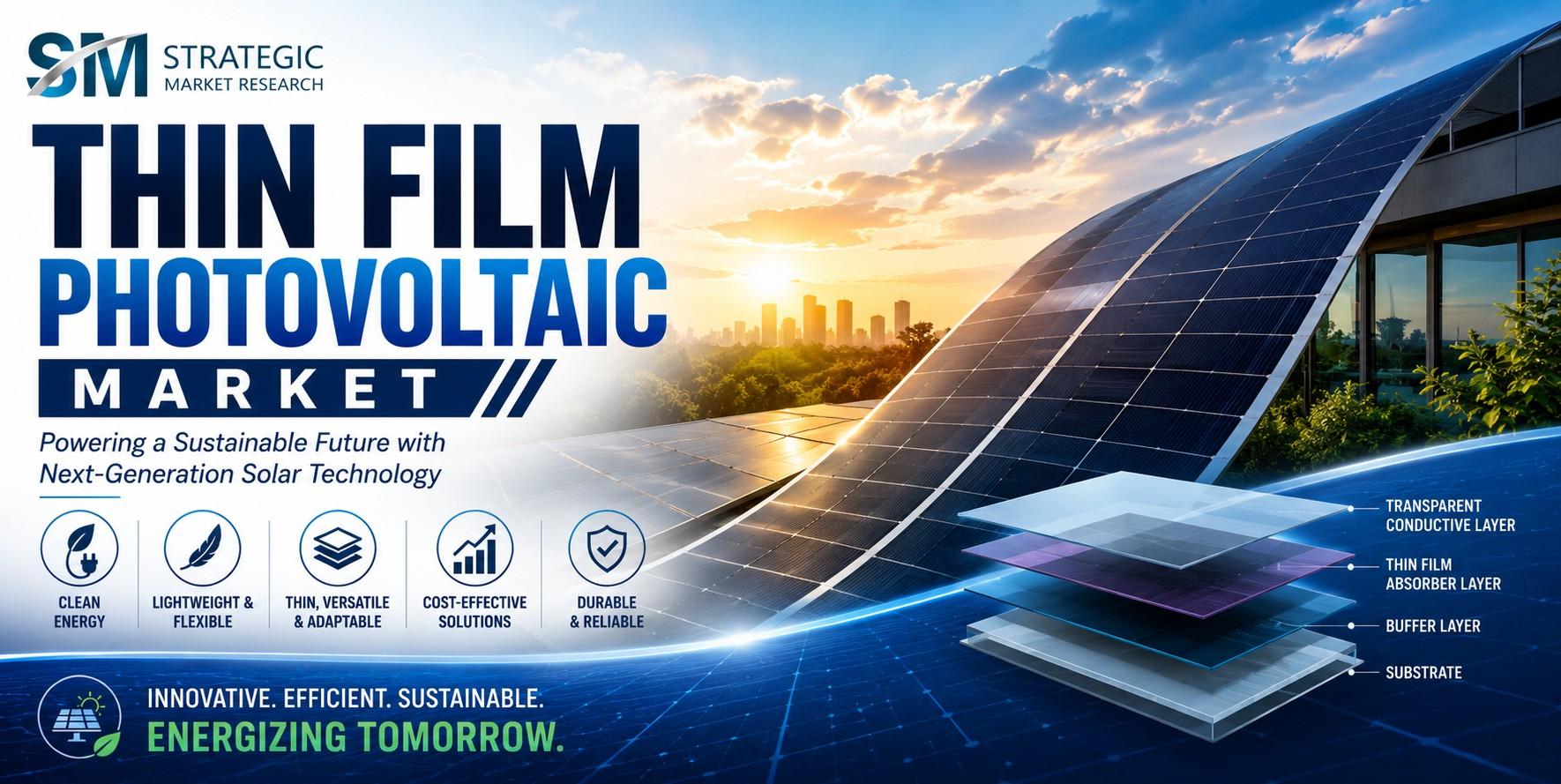
Thin Film Photovoltaic Market: Transforming Flexible and Lightweight Solar Power Technologies
The global thin film photovoltaic market is witnessing strong expansion as the renewable energy sector increasingly prioritizes lightweight, flexible, and economically efficient solar technologies for a wide range of applications. Thin film photovoltaic (PV) systems are manufactured using ultra-thin semiconductor layers deposited on substrates such as glass, plastic, and metal, allowing the development of highly adaptable solar modules compared to traditional crystalline silicon panels.
The market is expanding rapidly due to rising investments in renewable energy infrastructure, increasing deployment of building-integrated photovoltaics (BIPV), growing demand for portable solar solutions, and stronger decarbonization initiatives across industrial, commercial, and residential sectors. Thin film PV technologies are gaining traction in utility-scale solar farms, transportation infrastructure, aerospace systems, military energy applications, smart construction projects, and remote electrification programs.
Technological progress in cadmium telluride (CdTe), amorphous silicon (a-Si), copper indium gallium selenide (CIGS), and perovskite-based thin film materials is improving energy conversion efficiency, durability, and manufacturing scalability. As governments intensify renewable energy targets and carbon neutrality programs, thin film photovoltaics are becoming an increasingly strategic component of the global clean energy ecosystem.
Market Overview
Thin film photovoltaics are solar cells produced by depositing thin photovoltaic semiconductor layers onto supporting substrates. Unlike conventional crystalline silicon modules, thin film systems require significantly lower material usage and can be manufactured in flexible, lightweight, or semi-transparent formats.
These solar technologies offer multiple advantages, including lower production costs, reduced structural weight, improved performance under low-light conditions, and greater flexibility for unconventional installations. Thin film PV systems are particularly suitable for applications where traditional rigid solar panels are impractical due to space limitations, structural constraints, or design requirements.
The market encompasses several key technology segments, including:
- Cadmium Telluride (CdTe)
- Copper Indium Gallium Selenide (CIGS)
- Amorphous Silicon (a-Si)
- Organic Photovoltaics (OPV)
- Perovskite Thin Film Solar Cells
Growing commercialization of advanced high-efficiency modules and expanding global solar deployment are expected to strengthen long-term market growth.
Market Drivers
Increasing Investments in Renewable Energy Infrastructure
One of the major factors supporting the thin film photovoltaic market is the sharp rise in renewable energy investments worldwide. Governments, utilities, and private organizations are accelerating solar energy deployment to reduce reliance on fossil fuels and meet climate sustainability objectives.
Supportive policies such as tax credits, feed-in tariffs, renewable portfolio standards, and net-metering initiatives are encouraging solar adoption globally. Thin film photovoltaic technologies benefit from these developments due to their scalability and cost-effective manufacturing potential.
Large-scale solar projects are increasingly considering thin film modules because of their superior thermal performance and improved energy yield in high-temperature environments.
Growing Demand for Flexible and Lightweight Solar Systems
Demand for portable and lightweight solar technologies is significantly accelerating thin film photovoltaic adoption. Conventional crystalline silicon modules are often unsuitable for applications requiring mobility, curved installations, or low structural loading.
Thin film photovoltaics are increasingly deployed in:
- Portable solar charging systems
- Electric vehicles
- Recreational vehicles
- Aerospace platforms
- Building-integrated photovoltaics
- Wearable electronics
- Smart urban infrastructure
Their lightweight construction and flexible design enable installation on surfaces that cannot accommodate conventional solar panels.
Expansion of Building-Integrated Photovoltaics (BIPV)
The global focus on sustainable construction and green buildings is creating substantial demand for building-integrated photovoltaic systems. Thin film modules can be seamlessly integrated into windows, facades, rooftops, skylights, and curtain walls while preserving architectural aesthetics.
Semi-transparent and colored thin film technologies are allowing architects and developers to combine renewable energy generation with modern building design. The increasing adoption of net-zero energy buildings is expected to create long-term growth opportunities for thin film solar integration.
Enhanced Performance in Harsh Environmental Conditions
Thin film photovoltaic systems frequently outperform conventional silicon modules in low-light, cloudy, and high-temperature environments. This capability is especially valuable in regions with challenging climatic conditions where stable energy output is essential.
CdTe and CIGS technologies are increasingly preferred for desert solar installations and tropical environments because of their strong thermal stability and lower performance degradation under elevated temperatures.
Market Restraints
Lower Efficiency Relative to Crystalline Silicon Panels
Despite continuous technological advancements, many thin film photovoltaic technologies still operate at lower conversion efficiencies than advanced crystalline silicon modules.
While premium silicon solar panels often exceed 22% efficiency, several commercial thin film technologies remain below those performance levels. This creates limitations for installations where maximizing energy density and optimizing available space are critical.
Efficiency constraints may reduce adoption in residential rooftop systems with limited installation area.
Dependence on Specialized Raw Materials
Some thin film photovoltaic technologies rely on rare or limited raw materials such as indium, gallium, selenium, and tellurium. Supply chain disruptions and geopolitical dependencies related to these materials may create manufacturing risks and price volatility.
Concerns regarding long-term availability of specialized semiconductor materials remain a challenge for large-scale market expansion.
Environmental and Recycling Concerns
Certain thin film technologies, particularly cadmium telluride systems, face scrutiny regarding hazardous material handling and end-of-life disposal.
Although recycling capabilities are improving, environmental regulations associated with toxic material management may influence adoption in environmentally sensitive regions. Manufacturers are increasingly investing in recycling technologies and sustainable manufacturing practices to address these concerns.
Competition from Conventional Solar Technologies
The market also faces strong competition from rapidly evolving crystalline silicon technologies. Ongoing improvements in silicon module efficiency, manufacturing scale, and cost reduction are reducing the historical advantages held by thin film systems.
The dominance of established silicon supply chains further intensifies competitive pressure for thin film manufacturers.
Market Opportunities
Emerging Perovskite Solar Technologies
Perovskite-based thin film photovoltaics represent one of the most promising opportunities within the solar energy sector. These next-generation materials have demonstrated rapid improvements in efficiency while maintaining low production costs and flexible deployment capabilities.
Research organizations and manufacturers are increasingly developing tandem solar cells that combine perovskites with silicon or thin film architectures to achieve ultra-high efficiency performance.
Commercial-scale deployment of stable perovskite thin film modules could significantly reshape the future photovoltaic industry.
Expanding Use in Electric Vehicles and Transportation
Thin film photovoltaic systems are increasingly being integrated into electric vehicles, public transportation systems, marine applications, and autonomous mobility platforms. Lightweight solar modules can extend battery range and support auxiliary power functions without adding substantial vehicle weight.
Automotive manufacturers are exploring solar-integrated roofs and body panels to improve vehicle sustainability and energy efficiency.
Off-Grid Electrification and Remote Power Solutions
Thin film photovoltaics offer considerable potential for off-grid energy generation and rural electrification projects in developing economies. Their lightweight structure, portability, and simplified installation process make them highly suitable for remote power applications.
Governments and international development agencies are increasingly deploying portable solar technologies to improve electricity access in underserved regions.
Aerospace and Defense Sector Applications
Thin film photovoltaic technologies are gaining importance in aerospace and defense applications because of their lightweight properties and high adaptability. Military organizations use portable solar systems for field operations, while aerospace companies integrate thin film solar cells into satellites, drones, and high-altitude aerial platforms.
Flexible solar technologies provide significant operational advantages in mobile and mission-critical energy environments.
Competitive Landscape
The thin film photovoltaic market is characterized by rapid technological innovation, strategic collaborations, and ongoing manufacturing expansion. Companies are focused on improving conversion efficiency, reducing production costs, and enhancing module durability to strengthen competitive positioning.
Major market participants are investing in:
- Advanced semiconductor materials
- High-efficiency module technologies
- Roll-to-roll manufacturing systems
- Sustainable recycling infrastructure
- Integrated energy storage solutions
- Flexible solar module commercialization
Partnerships among solar manufacturers, automotive companies, construction firms, and energy developers are accelerating commercialization across multiple industries.
The market is also experiencing rising investment in next-generation technologies such as printable photovoltaics, tandem solar cells, and transparent solar films.
Market Forecast and Growth Trends
The thin film photovoltaic market is projected to experience strong growth over the coming decade as global solar deployment accelerates and demand for flexible renewable energy systems continues to rise.
Expansion of Utility-Scale Solar Projects
Large-scale solar farms are expected to remain a major growth driver for thin film photovoltaic technologies, particularly in regions with high solar radiation and elevated temperatures. Developers increasingly favor thin film modules because of their strong thermal efficiency and long-term energy generation performance.
Integration with Smart Building Infrastructure
The development of smart cities and energy-efficient infrastructure is supporting wider adoption of building-integrated photovoltaics. Thin film technologies are expected to play a significant role in future intelligent building ecosystems.
Advancements in Automated Manufacturing
Automation and roll-to-roll manufacturing processes are improving production scalability while reducing manufacturing expenses. Ongoing innovation in semiconductor engineering and deposition technologies is expected to strengthen commercial competitiveness.
Rising Demand for Portable Consumer Electronics
The growing market for portable power devices, wearable electronics, and IoT-enabled systems is generating new opportunities for compact thin film photovoltaic technologies.
Increasing Corporate Sustainability Initiatives
Businesses across industries are expanding renewable energy adoption as part of ESG and carbon reduction strategies. Thin film solar technologies offer greater deployment flexibility for commercial sustainability initiatives.
Latest Impact Analysis
Impact of Global Decarbonization Policies
Aggressive climate commitments and renewable energy mandates are accelerating investment in solar infrastructure worldwide. Governments are prioritizing domestic renewable manufacturing capabilities, supporting localized supply chains and technological innovation.
Impact of Energy Security Concerns
Volatility in global energy markets and rising fuel prices have strengthened interest in renewable energy independence. Thin film photovoltaics are increasingly viewed as a strategic solution for decentralized and resilient power generation.
Impact of Technological Advancements
Continuous improvements in semiconductor materials, flexible substrates, and tandem solar architectures are enhancing the commercial viability of thin film technologies. Research breakthroughs in perovskite efficiency and stability are expected to drive future market disruption.
Impact of Sustainable Manufacturing Practices
Manufacturers are increasingly focusing on environmentally responsible production methods, recyclable materials, and circular economy strategies. Sustainability-driven innovation is becoming an important competitive differentiator within the solar industry.
Conclusion
The thin film photovoltaic market is becoming an increasingly important segment of the global renewable energy industry, supported by growing demand for lightweight, flexible, and scalable solar technologies. Although challenges related to efficiency and raw material availability persist, ongoing advancements in semiconductor engineering and manufacturing innovation are steadily improving market competitiveness.
As solar energy adoption expands across utility-scale power generation, smart buildings, transportation systems, portable electronics, and off-grid infrastructure, thin film photovoltaics are expected to play a crucial role in the future of clean energy development. The emergence of next-generation materials such as perovskites, combined with accelerating global decarbonization efforts, is likely to unlock substantial long-term growth opportunities for the market.
Related Reports:
Monocrystalline Solar Cell Market
Nanocomposite Solar Cell Market
Dye Sensitized Solar Cell Market

 English
 French
 Spanish
 Portuguese
 Deutsch
 Turkish
 Dutch
 Italiano
 Russian
 Romaian
 Portuguese (Brazil)
 Greek